For observed order ranges, sampling timelines and delivery planning, see the Custom Umbrella Procurement Benchmark 2027.
Table of Contents
1. Define the Intended Use
Start with where and how the umbrella will be used. A compact umbrella for a hotel guestroom has different requirements from a golf umbrella for an outdoor event or an art umbrella for a museum shop.
- Retail: appearance, packaging, weight and repeatable quality are usually important.
- Corporate gifts: brand colour, logo position, presentation and delivery date often take priority.
- Hotels and hospitality: durability, easy handling and storage should be considered.
- Golf and outdoor events: canopy size, frame strength and wind performance may be more important.
- Museums and art projects: print resolution, colour control and panel alignment require careful sampling.
2. Choose the Umbrella Type and Size
Confirm both the open diameter and closed length. Umbrella names such as “21-inch” or “30-inch” normally refer to the rib length, not the finished canopy diameter.
| Umbrella type | Typical application | Points to confirm |
|---|---|---|
| Compact folding umbrella | Travel, retail, welcome kits | Closed length, weight, manual or automatic function |
| Straight umbrella | Hotels, retail, corporate gifts | Handle material, shaft, tip and overall length |
| Golf umbrella | Golf clubs, events, doormen | Open diameter, single or double canopy, frame construction |
| Fashion or art umbrella | Museums, galleries, designer brands | Artwork layout, colour, seam alignment and packaging |
For practical measurement guidance, see our umbrella measurement guide.
3. Select the Canopy Fabric
Polyester pongee is widely used because it is lightweight, water-repellent and suitable for several printing methods. RPET fabric is available for projects requiring recycled polyester, but the applicable material documentation should be confirmed for the specific order.
Fabric density, coating and colour can affect weight, print appearance, folding thickness and cost. Black UV coating, silver coating and other functional finishes should be tested on the selected material rather than assumed to perform identically across all fabrics.
4. Confirm the Frame and Operating System
The frame should be selected according to size, target weight, price and performance requirements. Fibreglass components offer useful flexibility, while steel and aluminium components may be appropriate for other constructions. Carbon fibre can reduce weight on selected premium models but increases cost.
Confirm the following:
- Manual, automatic-open or automatic-open-and-close operation
- Shaft material and diameter
- Rib and stretcher materials
- Number of ribs
- Single-canopy or vented double-canopy construction
- Handle material and shape
- Required open diameter, closed length and target weight
A frame test result belongs to the tested model and conditions. It should not be used as a blanket wind-resistance guarantee for every umbrella.
5. Select the Printing Method
Silk-Screen Printing
Suitable for simple logos and solid colours. Screen charges, print size, number of colours and panel positions should be confirmed before quotation.
Digital or Sublimation Printing
Suitable for photographs, artwork, gradients and full-canopy designs. Results depend on the artwork, fabric, coating and colour-management process.
Colour Matching
Provide Pantone C references for brand colours. Printed colour can appear different from a paper Pantone guide because fabric texture, base colour, coating, ink and lighting affect the result. When colour accuracy is important, approve a physical sample before bulk production.
For full-panel artwork, editable AI, CDR or vector PDF files are preferred. Raster images should normally be supplied at final print size with at least 200 DPI. We provide the correct panel template after the umbrella model is selected.
6. Specify Branding and Accessories
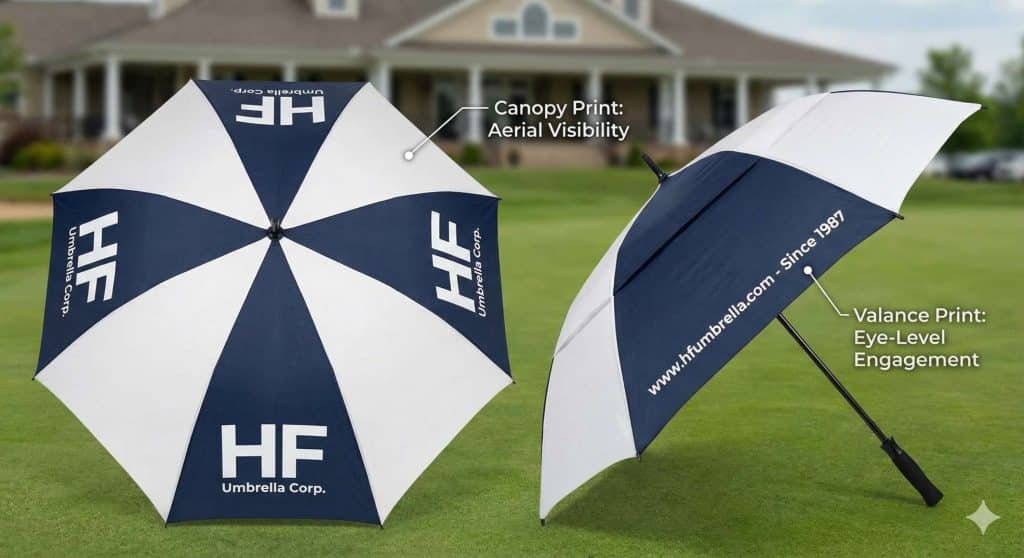
Branding can extend beyond the canopy. Depending on the model, options may include:
- Printed or woven closing strap
- Printed sleeve or zippered cover
- Handle decal, laser engraving or metal badge
- Woven label, care label or hangtag
- Custom top cap, ring or tip
- Retail box, individual polybag or protective packaging
Some combinations are not mechanically compatible. For example, a particular safety-close mechanism may restrict the available handle construction. Confirm compatibility before approving the design.
7. Agree on Quality Standards Before Production
The approved sample, signed artwork and written product specification should be the reference for production and inspection. The inspection plan may include dimensions, function, printing, workmanship, packing and order quantity.
For suitable orders, an AQL sampling plan such as AQL 2.5 for major defects and AQL 4.0 for minor defects can be agreed. Testing requirements—including opening-and-closing cycles, wind, rain, colourfastness or corrosion testing—should state the method, sample quantity and acceptance criteria.
Read our detailed umbrella quality testing and AQL inspection process and compliance documentation guide.
8. Confirm Sampling, Production and Delivery
Custom samples normally take 3–5 days after the model, materials and artwork are confirmed. Bulk production commonly takes 10–20 days after sample approval and deposit, but complex printing, special components, large quantities or peak-season capacity may require more time.
Shipping time is separate from production time. Express, air, sea and door-to-door services have different costs and transit times. For event orders, build in contingency time for artwork approval, sample revisions, production, customs and final delivery.
Custom Umbrella RFQ Checklist
For an accurate quotation, send the following information:
- Umbrella type or reference model
- Open diameter and closed length
- Quantity per design
- Canopy material and colour
- Logo or full-canopy artwork
- Printing positions and Pantone references
- Frame and handle requirements
- Sleeve, labels and packaging
- Destination country and postal code
- Required delivery date
- Applicable testing or compliance requirements
Frequently Asked Questions
What is the minimum order quantity?
Selected styles start from 25 pieces per design. The exact MOQ depends on the frame, fabric, printing method, packaging and level of customization.
Should I approve a sample before bulk production?
Yes. A physical sample is strongly recommended when colour, artwork alignment, structure, handle finish or packaging is important.
Can you match a Pantone colour exactly on fabric?
We use Pantone references for colour control, but fabric and paper are different substrates. A physical sample provides the most reliable approval reference for important brand colours.
What information affects the price most?
The main factors are umbrella construction, quantity, fabric, printing area, number of designs, handle and accessories, packaging, testing and delivery method.
Request a Specification Review
Send us your artwork, preferred umbrella style, quantity, destination and delivery date. Our team will review the specification and identify any printing, construction or scheduling risks before sampling.