
Waterproof vs. Water-Repellent Umbrella Fabric: What Buyers and Brands Need to Know
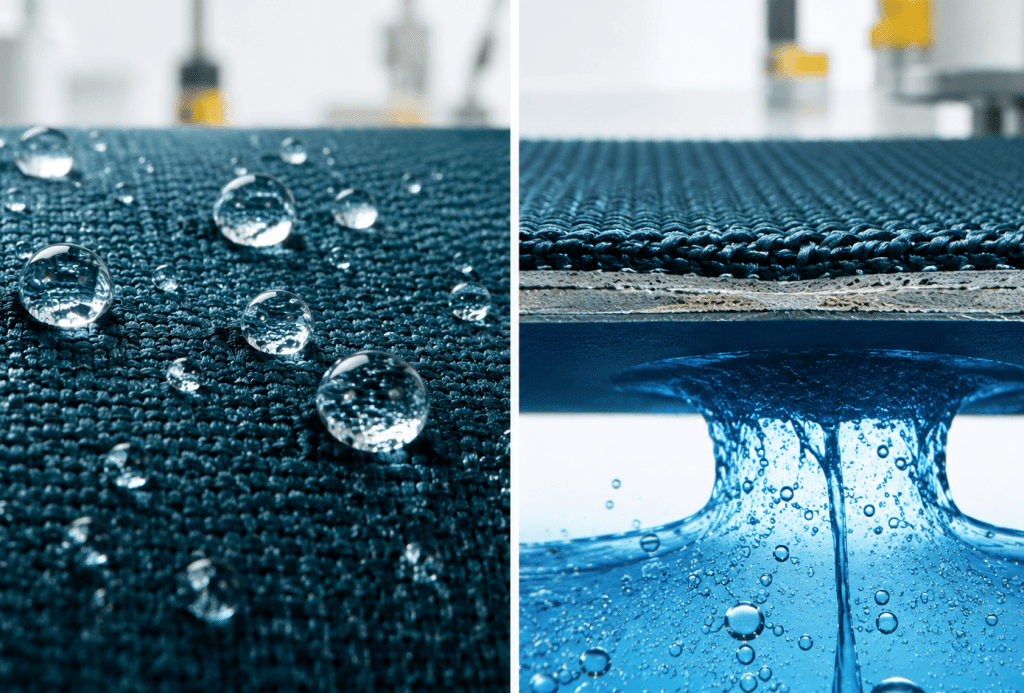
Water beads up and rolls off an umbrella canopy. Does that prove the fabric is waterproof?
Not necessarily.
For example, a fabric may show excellent water beading but allow water to penetrate under pressure. In contrast, another fabric may resist water penetration because of a back coating, even though its outer surface becomes visibly wet.
More importantly, a canopy fabric may pass a hydrostatic-pressure test while the finished umbrella still leaks through stitch holes, panel seams or the top-cap area.
KEY TAKEAWAY
Water beading ≠ waterproof performance.
A hydrostatic-pressure result ≠ leak-free umbrella seams.To specify an umbrella correctly, buyers must evaluate surface repellency, fabric penetration resistance and finished-product construction separately.
Manufacturers frequently use water-repellent, water-resistant and waterproof as if they mean the same thing. However, these terms describe different properties. Therefore, buyers must evaluate them with different test methods.
For custom umbrella buyers, the essential principle is:
Water repellency describes resistance to surface wetting. Water resistance describes resistance to water penetration. Finished-umbrella performance also depends on seams, stitch holes and construction.
Table of Contents
The Short Answer
| Property | What it describes | Typical test direction |
|---|---|---|
| Water repellency | Whether water wets the fabric surface | Spray test |
| Water resistance | Whether water penetrates the fabric | Hydrostatic-pressure, rain or impact test |
| Waterproof construction | Whether the complete product prevents unacceptable water entry | Product-specific testing |
| Water-vapor transmission | Whether water vapor can pass through the material | Separate breathability test |
These properties relate to one another. However, one result cannot prove all of them.
For instance, a spray test cannot establish hydrostatic resistance. Likewise, a hydrostatic-pressure result cannot prove that a finished umbrella will never leak through its seams.
What Does Water-Repellent Mean?
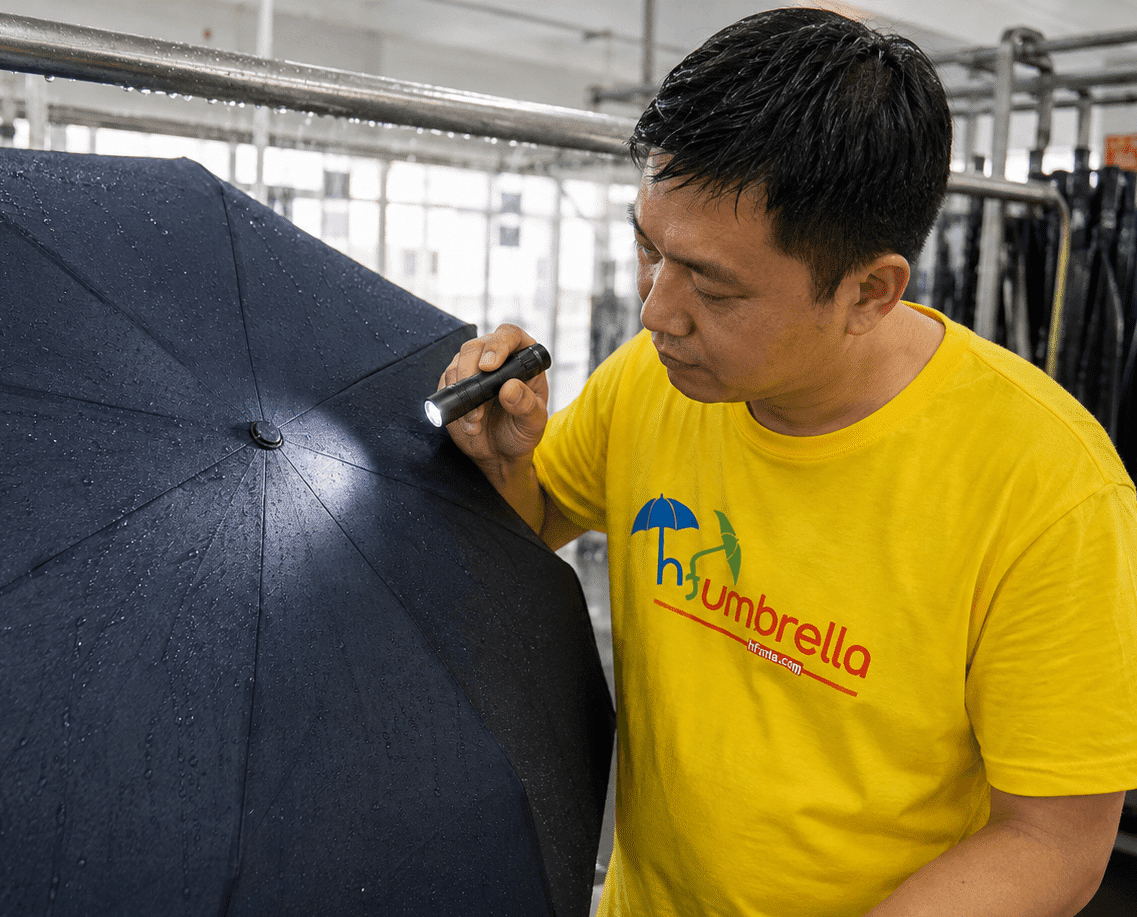
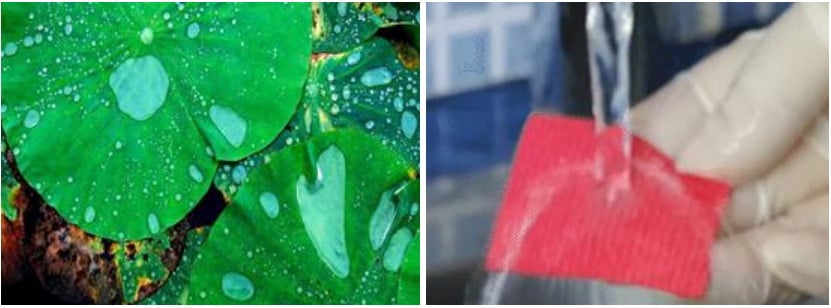
A water-repellent fabric resists surface wetting.
Textile finishers apply a water-repellent treatment to the fibers or fabric surface. As a result, liquid water is less likely to spread across or immediately soak into the material. Instead, water tends to form droplets, similar to the effect seen on a lotus leaf.
Importantly, the treatment does not necessarily block all the spaces between the yarns. Therefore, the fabric may remain permeable to air and water vapor while resisting surface wetting.
Common commercial descriptions include:
- Water-repellent
- Water-repellent finish
- Durable water repellent, or DWR
- Water-resistant finish
- WR finish
- C0 water-repellent finish
- Fluorine-free water repellent
However, WR can create confusion. Some suppliers use it for “water-repellent,” while others use it for “water-resistant.” Therefore, formal specifications and test reports should use the complete term.
How Do Laboratories Test Water Repellency?
Two widely recognized methods are:
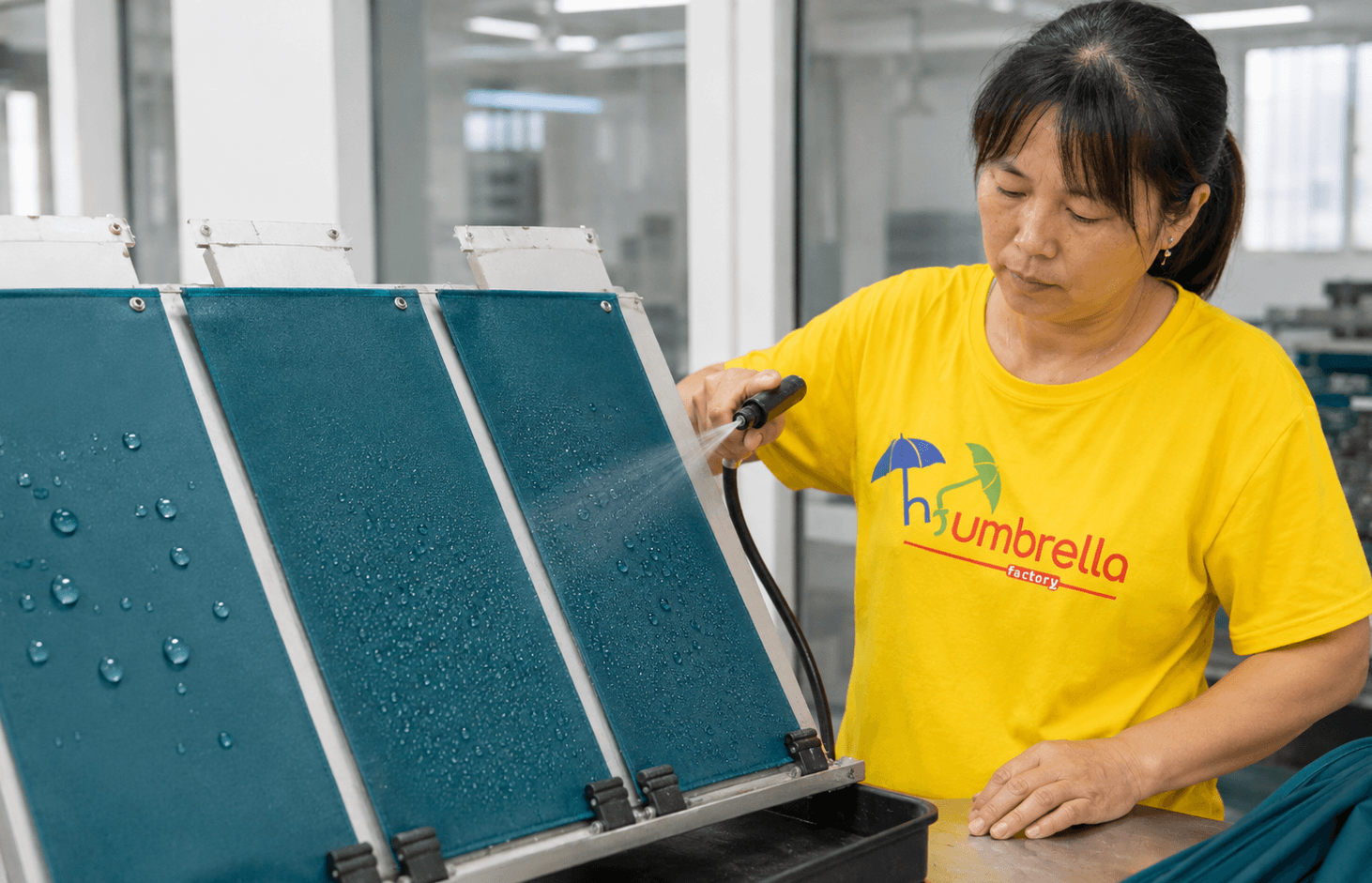
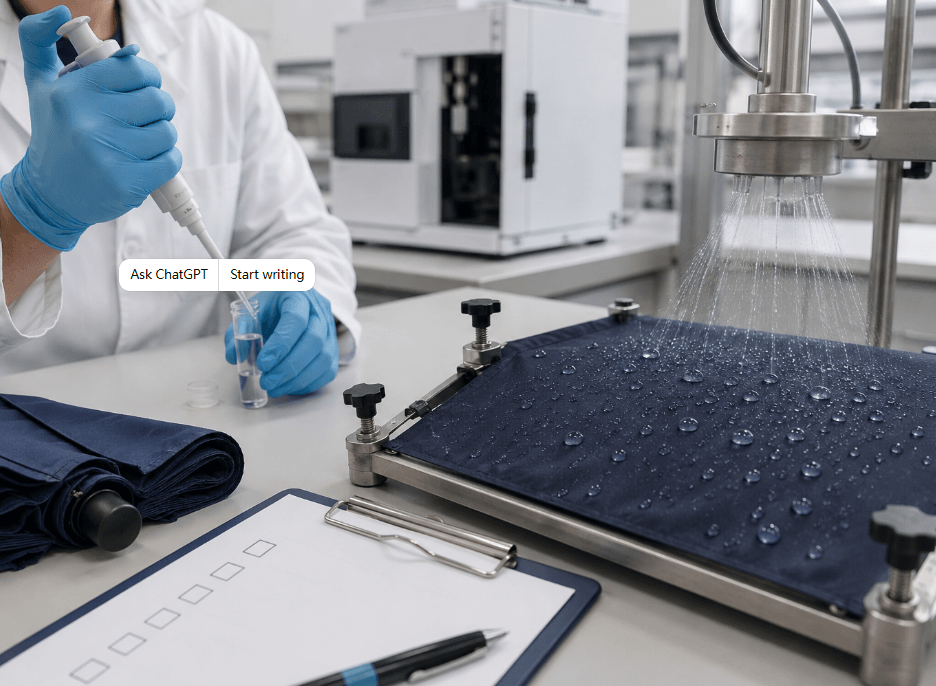
These methods evaluate how much of the fabric surface becomes wet after water reaches it through a controlled spray procedure.
However, ISO specifically states that its spray test does not predict resistance to rain penetration because it does not measure water passing through the fabric.
That distinction is fundamental:
A high spray rating means the surface resisted wetting. It does not automatically mean the fabric has high resistance to water penetration.
What Does Water-Resistant Mean?
Water resistance describes a material’s ability to resist water penetration under specified conditions.
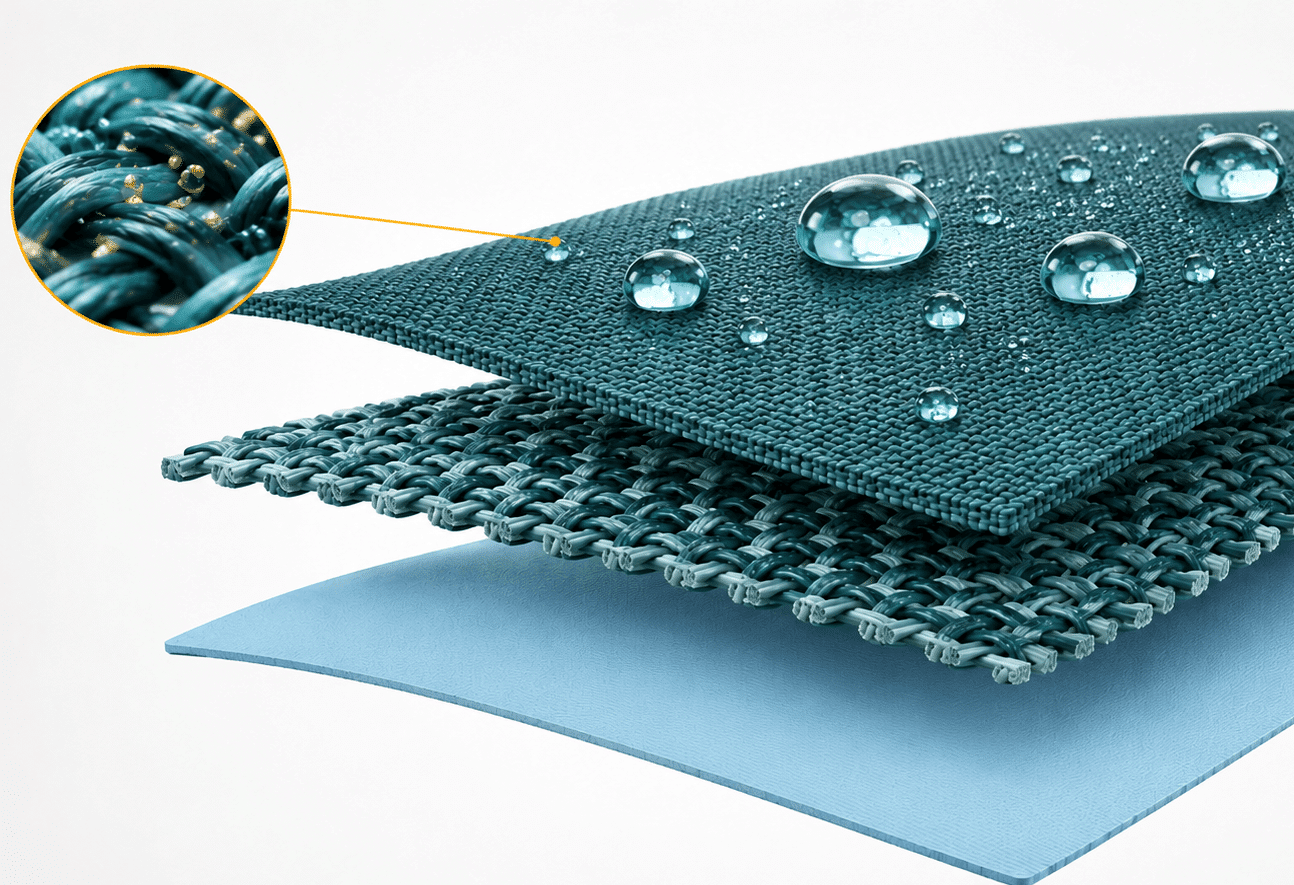
This resistance may come from one or more of the following:
- Dense fabric construction
- Fine yarns and tight weaving
- Fabric tension
- Calendaring or other mechanical finishing
- PU, acrylic, PVC or other coatings
- A laminated membrane
- Multiple fabric layers
- A combination of surface treatment and back coating
In contrast to surface repellency, water resistance focuses on whether water passes through the fabric.
How Do Laboratories Test Water Resistance?
A common laboratory method uses hydrostatic pressure.
ISO 811 — Determination of Resistance to Water Penetration: Hydrostatic-Pressure Test determines a fabric’s resistance to water penetration by applying increasing hydrostatic pressure. The standard applies to fabrics intended to resist water, whether or not they also have a water-repellent treatment.
Similarly, AATCC TM127 — Water Resistance: Hydrostatic Pressure measures a fabric’s resistance to water penetration under hydrostatic pressure.
Laboratories may report the results as:
- mmH₂O
- cmH₂O
- kPa
- Another pressure unit specified by the method
Therefore, the report must state both the unit and the test method. A number such as “1,000 mm” has little meaning unless the buyer also knows how the laboratory prepared and tested the specimen.
Is There a Universal Waterproof Rating?
No.
Online articles often repeat claims such as:
- 600 mm is the minimum waterproof level
- 1,000 mm is the European waterproof standard
- Waterproof fabric must achieve at least 3,000 mm
However, none of these figures represents a universal rule for every textile or product.
Instead, the appropriate requirement depends on:
- Product type
- Intended use
- Duration of water exposure
- Expected water pressure
- Fabric construction
- Test method
- Customer specification
- Regulatory or performance standard, if applicable
For example, a mountaineering jacket, tent floor, medical barrier and umbrella canopy operate under very different conditions.
A tent floor may remain pressed against wet ground. Meanwhile, a garment may experience pressure at the shoulders, elbows or knees. In contrast, an opened umbrella has a sloped canopy that allows water to run off quickly.
For this reason, applying a jacket or tent-floor requirement directly to an umbrella may create unnecessary cost. Moreover, a high fabric rating may still fail to address the actual leakage points of the finished umbrella.
A professional specification should define the test method, required result and product application instead of relying on an unsupported universal “waterproof” number.
What Does Waterproof Mean?
Manufacturers commonly use “waterproof” to describe a material or product that prevents unacceptable water penetration under its intended conditions of use.
However, buyers should not interpret it as an absolute promise that no water can ever pass through the material under unlimited pressure, exposure time or aging.
A responsible waterproof claim should answer four questions:
- What did the laboratory test—the fabric or the complete product?
- Which test method did it use?
- What result did the material or product achieve?
- Under which conditions should the product perform?
For example:
The canopy fabric was tested for hydrostatic resistance according to ISO 811.
This statement communicates more useful information than:
The umbrella is 100% waterproof.
In other words, the first statement identifies a measurable property. The second may imply that every seam, needle hole, top fitting and construction point remains permanently sealed under all conditions.
Waterproof Does Not Automatically Mean Vapor-Proof
Some older explanations define waterproof fabric as material that allows neither liquid water nor water vapor to pass.
That definition is incorrect.
Resistance to liquid-water penetration and water-vapor transmission are separate properties.
For example, a dense PVC coating may provide high water resistance with very low vapor transmission. However, a specially engineered membrane may resist liquid water while allowing a controlled amount of water vapor to pass.
For clothing, breathability affects comfort because perspiration vapor needs to escape. For most umbrella canopies, however, breathability is not an important requirement because the fabric does not sit against the body.
Therefore, an umbrella specification normally focuses on:
- Surface water repellency
- Resistance to water penetration
- Coating durability
- Drying behavior
- Leakage through construction points
Water-Repellent Finish, Coating and Lamination Are Not the Same
Factories and buyers frequently confuse these three processes. However, each one performs a different function.
Water-Repellent Finish
Textile finishers apply a water-repellent treatment to the fibers or fabric surface to reduce wetting.
The treatment normally does not create a continuous barrier across every opening in the textile. Instead, it primarily helps water form droplets and roll away.
Coating
Manufacturers generally apply a liquid or paste coating to one side of the fabric and then dry or cure it.
Umbrella fabrics may use coatings for:
- Water resistance
- UV protection
- Light blocking
- Color effects
- Heat shielding
- Added opacity
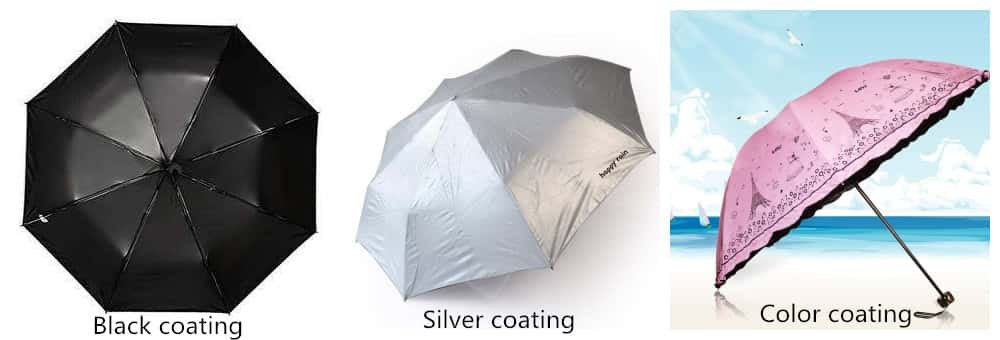
Common examples include clear PU coating, black coating and silver coating.
Lamination
Lamination combines the textile with a separately formed film, membrane or additional material layer.
Manufacturers commonly use laminated structures in technical apparel and engineered textile products. However, they use them less often in ordinary lightweight umbrellas because they must carefully control weight, stiffness, foldability and cost.
Why Does the Difference Matter?
A surface water-repellent finish and a continuous back coating perform different jobs.
Consequently, a fabric may have:
- Good water repellency but low hydrostatic resistance
- Poor surface water beading but good hydrostatic resistance
- Both good repellency and good hydrostatic resistance
- Neither
Therefore, buyers should select the preferred balance according to the umbrella model, fabric, coating, printing process and intended use.
Why Water Beading Does Not Prove Waterproof Performance
The lotus-leaf effect looks convincing. As a result, many suppliers use it in product demonstrations.
However, it shows only part of the story.
A newly treated fabric can produce attractive droplets during a short demonstration while still allowing penetration when:
- Water remains on the surface for longer
- The fabric experiences pressure
- Rain strikes the surface at speed
- The umbrella frame stretches the fabric
- Folding or abrasion damages the finish
- The coating contains pinholes
- Water reaches a seam or stitch hole
AATCC explains that TM22 offers a quick method for screening resistance to surface wetting. However, suppliers should not present it as proof of every aspect of water resistance. AATCC: The Art of Testing Water Repellency
Therefore, a video showing droplets rolling off an umbrella can support a surface-repellency claim. It cannot, by itself, support a precise hydrostatic-pressure or complete-product waterproof claim.

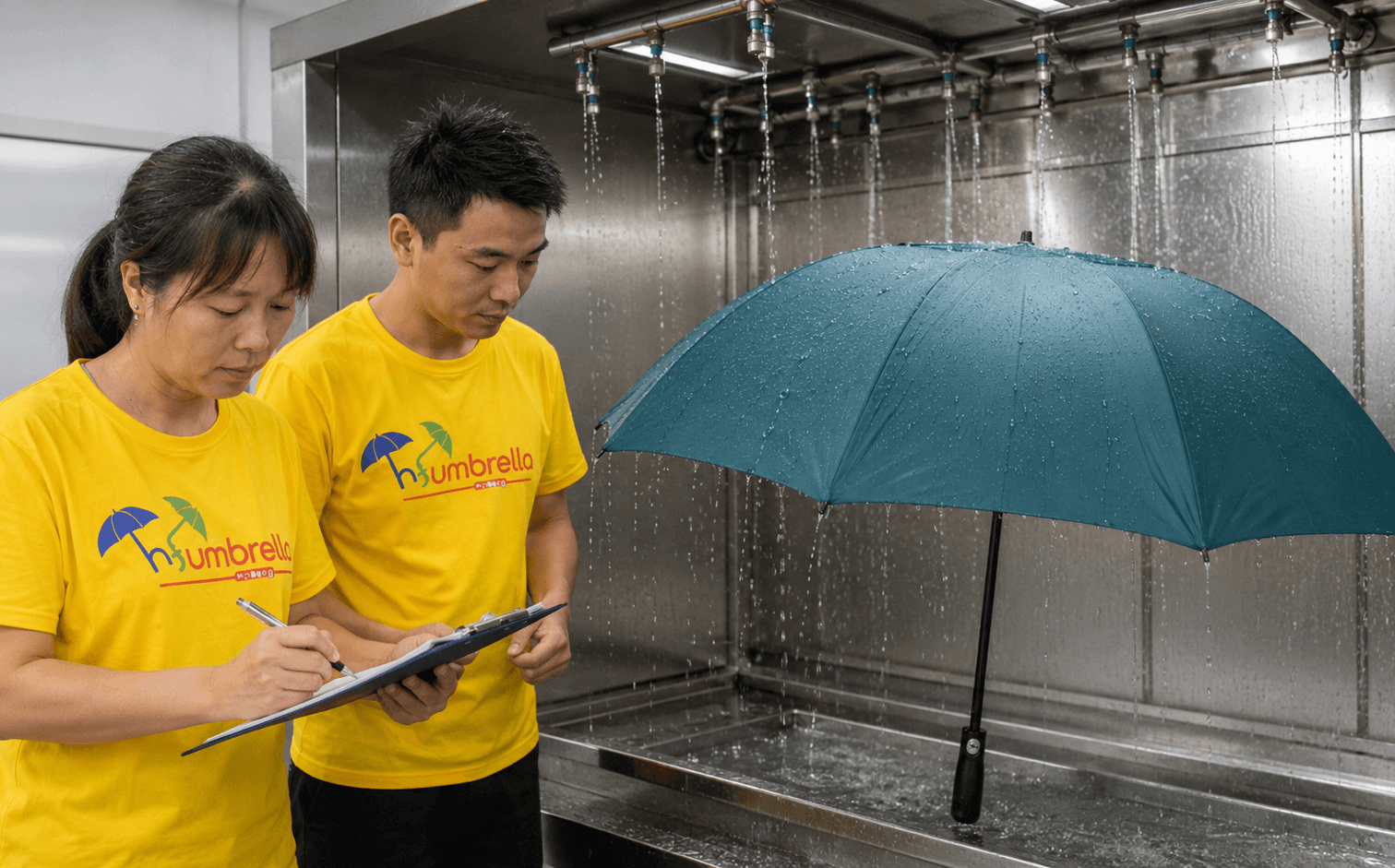
Why Hydrostatic Pressure Does Not Prove a Finished Umbrella Is Waterproof
Laboratories normally perform hydrostatic testing on a flat fabric specimen rather than on a complete umbrella.
However, the finished canopy introduces additional potential water-entry points:
- Panel seams
- Stitch holes
- Top-cap opening
- Ferrule or tip area
- Tie-wrap attachment
- Labels stitched through the canopy
- Vented-canopy openings
- Local coating damage caused by sewing
- Fabric tension around ribs and tips
Therefore, the fabric may pass a hydrostatic-pressure requirement while water still enters through one of these areas.
Fabric testing and finished-product testing answer different questions:
| Test object | Question answered |
|---|---|
| Flat fabric | How strongly does the material resist water penetration? |
| Coated fabric | Does the coating improve the water barrier? |
| Sewn canopy | Do the panel seams and stitch holes leak? |
| Finished umbrella | Does the complete product perform acceptably in simulated rain? |
Waterproof fabric does not automatically create a waterproof product. Construction quality still matters.
Why Umbrella Seams Differ from Waterproof-Garment Seams
Waterproof-jacket manufacturers often apply seam-sealing tape over the inside of stitched seams.
However, ordinary umbrellas generally do not use the same construction.
An umbrella canopy must:
- Fold repeatedly into a narrow package
- Remain flexible
- Open under tension
- Move in strong wind
- Avoid excessive weight and bulk
- Maintain an acceptable appearance from both sides
Applying seam tape to every radial canopy seam may:
- Increase stiffness
- Affect folding
- Add visible bulk
- Increase weight and cost
- Interfere with double-canopy ventilation
- Delaminate after repeated folding
- Alter the appearance of the inner canopy
Instead, umbrella water performance usually depends on a balanced combination of:
- Appropriate canopy fabric
- Suitable surface treatment or coating
- Controlled needle size
- Appropriate stitch density
- Good sewing quality
- Correct seam construction
- Proper top-cap assembly
- Sufficient canopy slope
- Finished-umbrella rain testing
Special applications may require additional sealing. Nevertheless, manufacturers should not copy garment construction blindly onto an umbrella.
Which Water Tests Apply to Umbrella Fabric?
Different test methods answer different questions. Therefore, buyers should select the method that matches the required claim.
1. Surface-Wetting Test
Examples: AATCC TM22 and ISO 4920
Measures: Resistance to surface wetting
Useful for: Evaluating water-repellent finishing
Does not prove: Hydrostatic resistance or finished-umbrella leakage
2. Hydrostatic-Pressure Test
Examples: AATCC TM127 and ISO 811
Measures: Resistance to water penetration under increasing pressure
Useful for: Comparing fabrics and coatings
Does not prove: Complete umbrella construction is leak-free
3. Rain Test
Example: AATCC TM35 — Water Resistance: Rain
Measures: Water penetration through fabrics or fabric combinations at specified rain intensities
Useful for: Evaluating performance under simulated rain conditions
AATCC describes TM35 as a method for measuring the water-penetration resistance of fabrics or fabric combinations at different rain intensities. AATCC TM35
4. Impact-Penetration Test
Example: AATCC TM42 — Water Resistance: Impact Penetration
Measures: Resistance to water penetration caused by water impact
Useful for: Comparing how materials respond to impacting water
AATCC lists TM42 separately from its spray, rain and hydrostatic-pressure methods because each test evaluates a different water-exposure mechanism. AATCC water-resistance and repellency methods
5. Finished-Umbrella Rain Test
Measures: Leakage or abnormal wetting in the assembled product
Useful for: Checking seams, stitch holes, top-cap construction and the overall canopy
The buyer and testing team should define:
- Rain intensity
- Spray direction
- Test duration
- Umbrella opening angle
- Whether the procedure simulates wind
- Acceptable leakage criteria
- Inspection points
In practice, a finished-product rain test should supplement relevant fabric tests rather than replace them.
How Do Coatings Affect Umbrella Performance?
Clear PU Coating
A clear or lightly colored PU coating can increase water resistance while preserving the outside color and printed appearance.
Black Coating
Brands often select black coating for UV protection, opacity and light blocking. In addition, it may influence water resistance, fabric flexibility and the appearance of the outer canopy.
Silver Coating
Silver coating can provide reflectivity and UV-related performance. However, buyers should evaluate its formulation, adhesion and folding durability separately from surface water repellency.
Digital Printing and Coating
Digital printing, sublimation, surface treatments and back coatings may affect:
- Hand feel
- Surface energy
- Color appearance
- Water beading
- Hydrostatic performance
- Coating adhesion
- Fold durability
Therefore, a result obtained from an unprinted fabric may not represent the final printed and coated canopy.
For this reason, the laboratory should test material that represents the planned bulk production.
Durability: Initial Performance Is Not the Whole Story
Initially, a newly finished fabric may show excellent water beading. However, that performance can change after:
- Repeated opening and closing
- Folding and compression
- Abrasion against ribs and neighboring panels
- Exposure to dust, oil or detergent
- Heat and humidity
- UV exposure
- Long-term storage
- Coating aging or hydrolysis
For washable garments, laboratories often test performance after laundering. Umbrellas rarely undergo machine washing. Therefore, their more relevant durability risks include repeated folding, surface contamination, weather exposure and coating aging.
Potential failures include:
- Reduced water beading
- Localized wetting
- Coating cracks
- Pinholes
- Delamination
- Sticky coating
- Color transfer between folded panels
- Leakage around seams or the top cap
Consequently, buyers should decide whether they need only an initial test result or a durability requirement after defined conditioning.
Does Water-Repellent Finishing Always Contain PFAS?
No.
Historically, textile manufacturers widely used fluorinated chemistry because it could provide strong water, oil and stain repellency.
However, manufacturers increasingly use non-fluorinated water-repellent systems to meet regulatory developments and brand requirements.
Suppliers may use terms such as:
- PFAS-free
- Fluorine-free
- Non-fluorinated
- C0 water repellent
Nevertheless, buyers should not accept these terms without defining their meaning and verification method.
A product can provide water repellency without providing oil repellency. Moreover, most umbrellas do not require strong oil repellency. Therefore, non-fluorinated water-repellent systems may offer a suitable solution.
ECHA documentation confirms that manufacturers have historically used PFAS-related substances to provide water-, oil- and stain-repellent properties in textiles and other materials. ECHA PFAS documentation
A PFAS-related requirement should separately define:
- Restricted-substance list
- Named PFAS scope
- Test method
- Reporting limit
- Whether the client requires total-fluorine or total-organic-fluorine screening
- Whether the restriction covers only intentionally added PFAS
- Whether coatings, prints and accessories fall within the testing scope
In other words, both “PFAS-free” and “waterproof” sound simple, but buyers must define them precisely.
Why Buyers Should Avoid “W/R” and “W/P” Alone
Factories commonly use W/R and W/P during informal discussions. However, these abbreviations can create confusion.
W/R may mean:
- Water-repellent
- Water-resistant
W/P may mean:
- Waterproof
- Water pressure
- Another company-specific abbreviation
Therefore, a professional umbrella specification should state both the required performance and test method clearly.
Instead of writing:
210T pongee, W/R + W/P
Write:
210T pongee with a fluorine-free water-repellent finish; surface wetting tested according to ISO 4920; hydrostatic resistance tested according to ISO 811.
The second version gives the buyer, factory and testing laboratory the same understanding.

What Should an Umbrella Buyer Specify?
Before production, buyers should confirm the following points.
Canopy Construction
- Fabric type
- Fabric density
- Yarn specification, if required
- Single or double canopy
- Vented or non-vented construction
Surface Treatment
- Water-repellent finish required
- Fluorinated or non-fluorinated requirement
- PFAS-verification scope
- Required spray rating
- Durability condition, if applicable
Water-Penetration Resistance
- Test method
- Required hydrostatic-pressure result
- Test side and specimen condition
- Coating type
- Whether the laboratory must test printed and coated production fabric
Finished-Umbrella Performance
- Rain-test procedure
- Test duration
- Acceptable leakage
- Seam and top-cap inspection
- Sampling level
- Whether testing occurs before or after open-close cycling
Documentation
- Laboratory report
- Supplier declaration
- Production-material identification
- Approval sample
- Bulk-production inspection record
HF Umbrella’s Recommended Verification Approach
At HF Umbrella, we do not treat “waterproof” as a single checkbox.
Instead, we select an appropriate verification process according to the umbrella model, fabric, coating, printing method, intended market and buyer requirement.
1. Define the Expected Use
First, we confirm how and where the client will use the umbrella.
For example, a promotional umbrella, golf umbrella, UV umbrella and technical outdoor umbrella may require different performance levels.
2. Confirm the Fabric and Coating
Next, we confirm the final fabric, coating and printing method.
Testing an uncoated stock fabric does not prove the performance of the final printed and coated canopy.
3. Separate Repellency from Penetration Resistance
We then distinguish surface water repellency from resistance to water penetration.
This step allows the client to choose the appropriate test for each required claim.
4. Approve a Representative Sample
Afterward, we produce a sample with the intended fabric, coating, printing and sewing construction.
Therefore, the client can evaluate a product that represents the planned production instead of relying on an unrelated stock material.
5. Check the Finished Umbrella
Next, we inspect the seams, stitch holes, top cap and other potential water-entry points.
If necessary, we also perform or arrange an agreed finished-umbrella rain test.
6. Retain the Approved Standard
Both parties should retain the confirmed material and finished sample.
As a result, the production and QC teams have a clear physical reference for bulk-production comparison.
7. Avoid Unsupported Claims
Finally, we recommend stating the test method and result whenever a buyer requires a technical water-repellent or waterproof claim.
This process gives the client a more reliable answer than simply pouring water onto a piece of fabric and watching it form droplets.

Common Misunderstandings
“Water forms droplets, so the fabric is waterproof.”
Not necessarily. The demonstration mainly shows resistance to surface wetting.
“The fabric passed a hydrostatic-pressure test, so the complete umbrella cannot leak.”
Not necessarily. Water may still enter through seams, stitch holes or the top-cap area.
“Waterproof fabric cannot transmit water vapor.”
Incorrect. Liquid-water resistance and water-vapor transmission are separate properties.
“Every waterproof textile must exceed 3,000 mm.”
Incorrect. No universal threshold applies to every product and application.
“A more waterproof coating always makes a better umbrella.”
Not necessarily. Excessive coating can increase weight and stiffness, affect folding, change color, reduce flexibility and create aging risks.
“All water-repellent finishes contain PFAS.”
Incorrect. Non-fluorinated systems are available. However, a PFAS-free claim still requires a defined verification scope.
“W/R means the same thing to every supplier.”
It does not. Therefore, specifications should use complete terminology and identify the test method.
Frequently Asked Questions
Is ordinary polyester umbrella fabric waterproof?
Polyester fiber alone does not automatically make an umbrella waterproof. Instead, performance depends on fabric density, finishing, coating, canopy tension and construction.
Is pongee more waterproof than polyester?
Pongee normally refers to a type of woven polyester fabric used for umbrellas. Therefore, “polyester” identifies the fiber, while “pongee” describes a fabric construction or trade category.
Water performance depends on the finished material rather than the name alone.
Does black coating make umbrella fabric waterproof?
Black coating may improve water resistance, opacity and UV-related performance. However, the actual result depends on the coating formulation, thickness, adhesion and fabric construction.
Therefore, buyers should test the material instead of assuming its performance.
Is a spray test enough for an umbrella?
A spray test helps evaluate surface water repellency. However, if the buyer also requires resistance to water penetration, the project may need hydrostatic, rain or other appropriate testing.
Why does an umbrella sometimes leak at the seams?
Sewing needles create holes in the canopy. In addition, leakage can result from seam construction, stitch density, thread, top-cap assembly or local coating damage.
Can Manufacturers Seal Umbrella Seams Like Waterproof-Jacket Seams?
Manufacturers can add sealing in some designs. However, conventional garment seam tape may increase stiffness, weight and bulk. It may also affect repeated folding.
Therefore, the development team must evaluate the complete umbrella design.
How Should We Describe a Water-Repellent Umbrella Accurately?
A suitable description is:
The canopy has a water-repellent surface finish that helps rain form droplets and roll off. Water-penetration resistance depends on the fabric construction, coating and finished-umbrella assembly.
Can HF Umbrella Arrange Laboratory Testing?
Yes, depending on the project and client requirements.
However, the buyer and supplier should confirm the test standard, performance target, material scope and reporting requirements before sampling or bulk production. This ensures that the laboratory evaluates the correct property.
Final Takeaway
The difference between water repellency and waterproof performance is not merely a matter of terminology.
Instead, it affects:
- Material selection
- Coating decisions
- Product claims
- Test methods
- Compliance documents
- Quality control
- Customer expectations
- Complaint risk
Finally, buyers should remember five rules:
- Water beading does not prove resistance to water penetration.
- Hydrostatic resistance does not prove that every finished-umbrella seam is leak-free.
- No universal waterproof-pressure threshold applies to every textile product.
- Water repellency, water resistance, water-vapor transmission and finished-product leakage require separate evaluation.
- A technical claim should identify the test method, result and tested material.
HF Umbrella helps brands select the appropriate fabric, finish, coating and verification method for each custom umbrella project.
Send us your umbrella model, intended market, performance requirement and testing standard. We will help you build a specification that is measurable, manufacturable and appropriate for the product.