
Sustainability claims are easy to print on a swing tag. They are much harder to defend when a retailer, brand compliance team or customer asks for evidence.
We have worked in custom umbrella manufacturing for more than 30 years. During that time, the questions from buyers have changed. Twenty years ago, most conversations focused on price, colour and delivery. Today, buyers also ask where the fabric came from, what the water-repellent treatment contains, whether the wooden handle has traceable sourcing, and which documents apply to their actual shipment.
That change is healthy. It also creates confusion.
A canopy made from recycled polyester does not automatically make the whole umbrella recyclable. A supplier’s GRS Scope Certificate does not automatically certify every umbrella leaving its factory. Likewise, an “SGS tested” statement means very little unless the buyer sees the test method, substances tested, reporting limits and sample description.
This guide explains how we advise buyers to specify, verify and purchase more sustainable custom umbrellas without paying for claims that cannot be supported.
Table of Contents
What Does “Sustainable Umbrella” Actually Mean?
There is no single material or certificate that turns an umbrella into a sustainable product. Buyers need to look at several parts of the product together:
- Material inputs: Does the canopy contain verified recycled material? Are wood-based components responsibly sourced?
- Chemical management: Does the fabric meet the buyer’s restricted-substance requirements? Has the water-repellent finish been tested for the relevant PFAS substances?
- Durability: Will the frame, canopy and opening mechanism survive normal use?
- Manufacturing: Does the factory control waste, energy, chemicals and product quality?
- Packaging: Can the supplier reduce unnecessary plastic and oversized cartons?
- Traceability: Can the supplier connect its claims to the material, factory and shipment involved?
- End of life: Can parts be repaired, reused or separated where suitable recycling channels exist?
These factors sometimes conflict. For example, a very lightweight umbrella may use less material, but a weak frame that breaks after several uses is not a good environmental outcome. In practice, the most sustainable umbrella is usually one that combines lower-impact materials with a construction strong enough for a long service life.
RPET Canopy Fabric: Useful, but Not the Whole Story
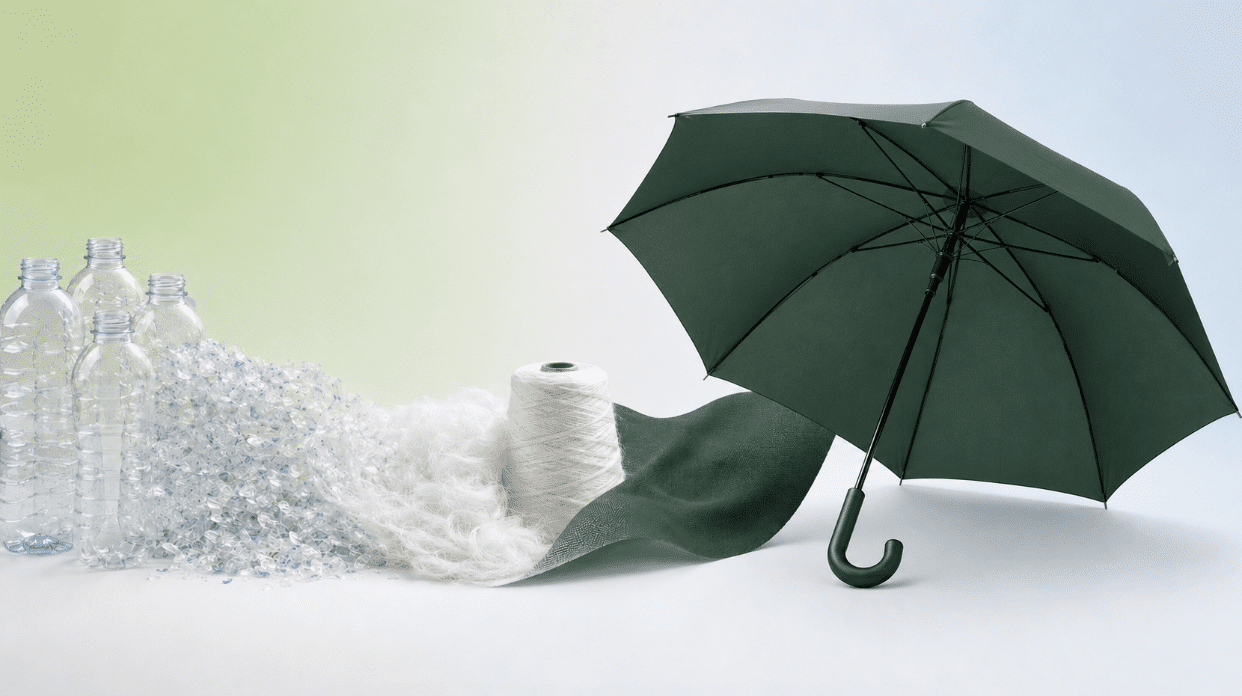
RPET is recycled polyethylene terephthalate, usually produced from post-consumer PET packaging such as plastic bottles. Manufacturers clean and process the collected PET into flakes, chips, yarn and woven polyester fabric.
The finished material can look and perform much like conventional polyester. Therefore, buyers can use it for folding umbrellas, straight umbrellas, golf umbrellas and many custom-printed promotional models.
You may see RPET umbrellas described as umbrellas with canopies made from recycled plastic bottles. That is a useful plain-English explanation, but bottle-count claims need context. The equivalent number of bottles depends on:
- the size of the canopy;
- fabric weight in grams per square metre;
- the verified percentage of recycled content;
- the assumed weight of each bottle;
- cutting and weaving losses; and
- whether the calculation covers the canopy alone or the entire product.
For that reason, we do not recommend treating “made from 10 bottles” as proof by itself. Ask the supplier to explain the calculation and provide documentation for the recycled input.
RPET also does not make the complete umbrella recyclable. A typical umbrella still contains steel, aluminium, fibreglass, plastic, thread, labels and sometimes adhesive. RPET can reduce demand for virgin polyester, but it is one part of a wider product decision.
GRS Scope Certificates and Transaction Certificates Are Different
This is one of the most important checks in recycled-material procurement.
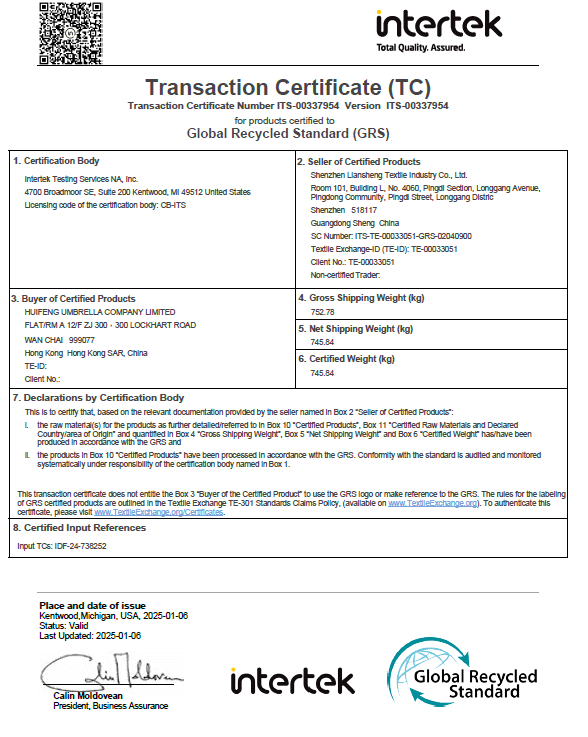
A Scope Certificate, often called an SC, confirms that a named organisation and specified sites are certified to process or trade particular product categories under the relevant standard during the certificate’s validity period. It establishes capability and scope. It does not prove that every item sold by the company is certified.
A Transaction Certificate, or TC, relates to certified goods sold or shipped from one organisation to another. It records information such as the seller, buyer, shipment, product and certified material volume.
Textile Exchange states that only products accompanied by the relevant transaction documentation are considered certified. In addition, the chain of custody must remain intact through the applicable stages of the supply chain.
Before ordering custom RPET umbrellas, ask:
- Which company will invoice and ship the finished umbrellas?
- Is that company included in a valid certification scope for the relevant product and processing category?
- Can the relevant shipment receive a TC?
- Does the documentation cover fabric only, or the finished umbrella?
- Will the buyer’s company name and shipment details appear correctly?
- Are there additional certification, transaction or labelling charges?
If a supplier can only provide its fabric mill’s Scope Certificate, the buyer may still purchase genuine recycled fabric. However, the buyer should not present the finished umbrella as GRS-certified unless the certification and chain-of-custody requirements support that claim.
PFAS-Free Umbrellas: Define What You Want Tested
Umbrella fabric needs a water-repellent finish. Historically, some textile finishes used fluorinated chemistry because it delivered strong water, oil and stain repellency. Regulatory scrutiny and customer requirements have pushed the textile industry towards non-fluorinated alternatives.
The phrase “PFAS-free” sounds simple, but laboratory verification is not a single universal test.
One report may test a short list of named PFAS substances. Another may test a broader list. Total fluorine or total organic fluorine screening can provide additional information, but it does not identify every individual compound. Results also depend on the laboratory method and reporting limit.
Therefore, a serious specification should state:
- the market where the umbrellas will be sold;
- the customer’s restricted-substances list;
- the PFAS analytes or screening method required;
- the reporting limits;
- whether the test covers fabric, coating, print and other treated components;
- the accredited laboratory requirement; and
- whether testing must use pre-production material or finished production goods.
Avoid requesting “0 ppm PFAS” without defining a test method. Laboratories normally report results as below a stated detection or reporting limit, rather than proving an absolute zero.
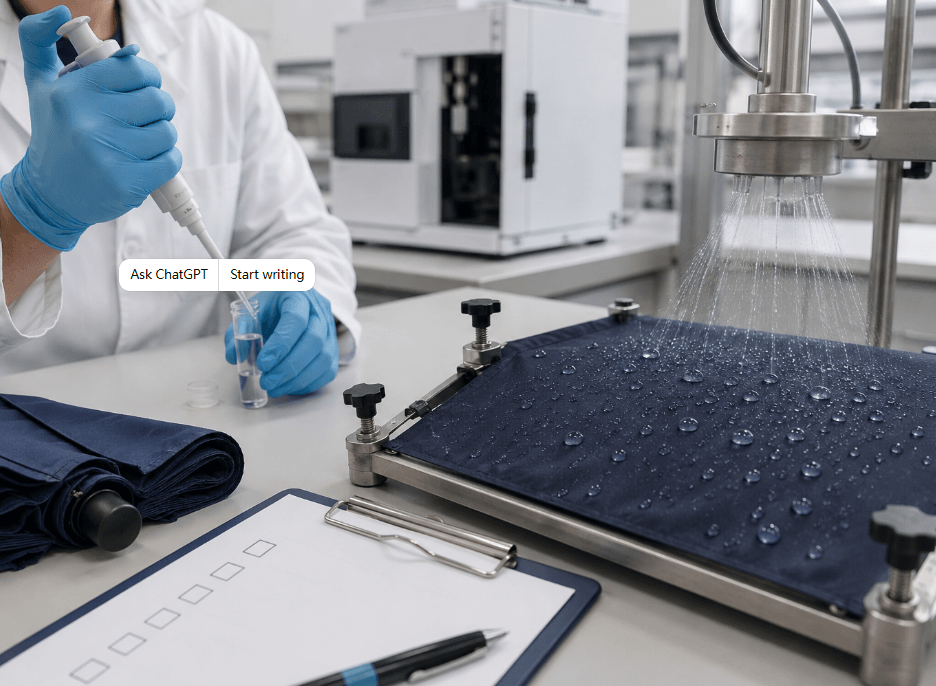
PFAS-free durable water-repellent finishes can work well for umbrellas. Still, performance varies with fabric construction, coating chemistry, application weight and curing conditions. Test chemical compliance and rain performance separately. One does not prove the other.
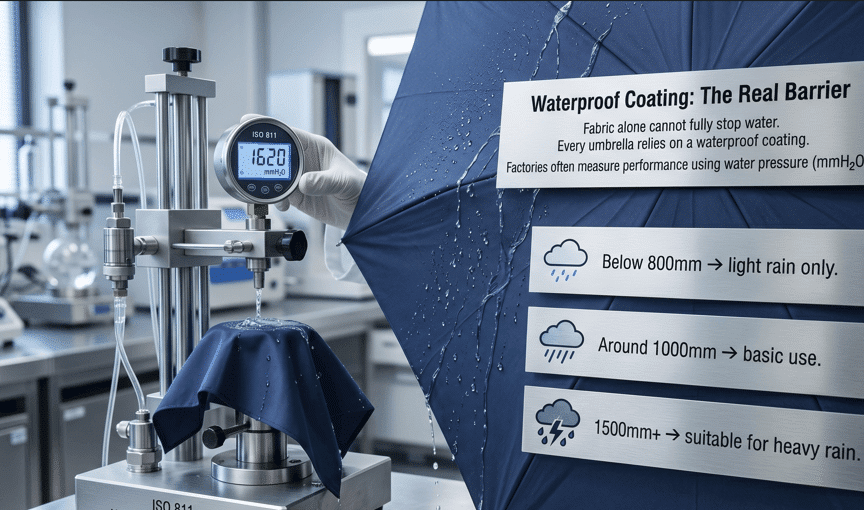
Water Resistance: Test the Finished Specification
An umbrella is not an outdoor jacket, and it is not a camping tent. Buyers should select meaningful tests instead of copying an unrelated textile specification.
Common checks include:
- ISO 4920 spray testing to assess surface wetting;
- ISO 811 hydrostatic pressure testing where a measurable water-pressure requirement is relevant;
- finished-umbrella rain testing;
- seam and stitch inspection;
- coating adhesion or ageing checks when required; and
- colourfastness testing for printed or dyed fabric.
A high hydrostatic-head result on a fabric swatch does not guarantee that a completed umbrella will remain dry. Water can enter through stitching, panel seams or the top assembly. Consequently, we recommend combining material testing with a finished-product rain test.
For ordinary rain umbrellas, extremely high waterproof figures may add cost without improving the customer’s actual experience. The correct target should reflect the umbrella type, intended retail claim and buyer’s test protocol.
FSC Wood and Bamboo Components
Wooden and bamboo handles can reduce the visible use of conventional plastic and give an umbrella a warmer, more premium appearance. However, “natural” and “sustainable” are not interchangeable.
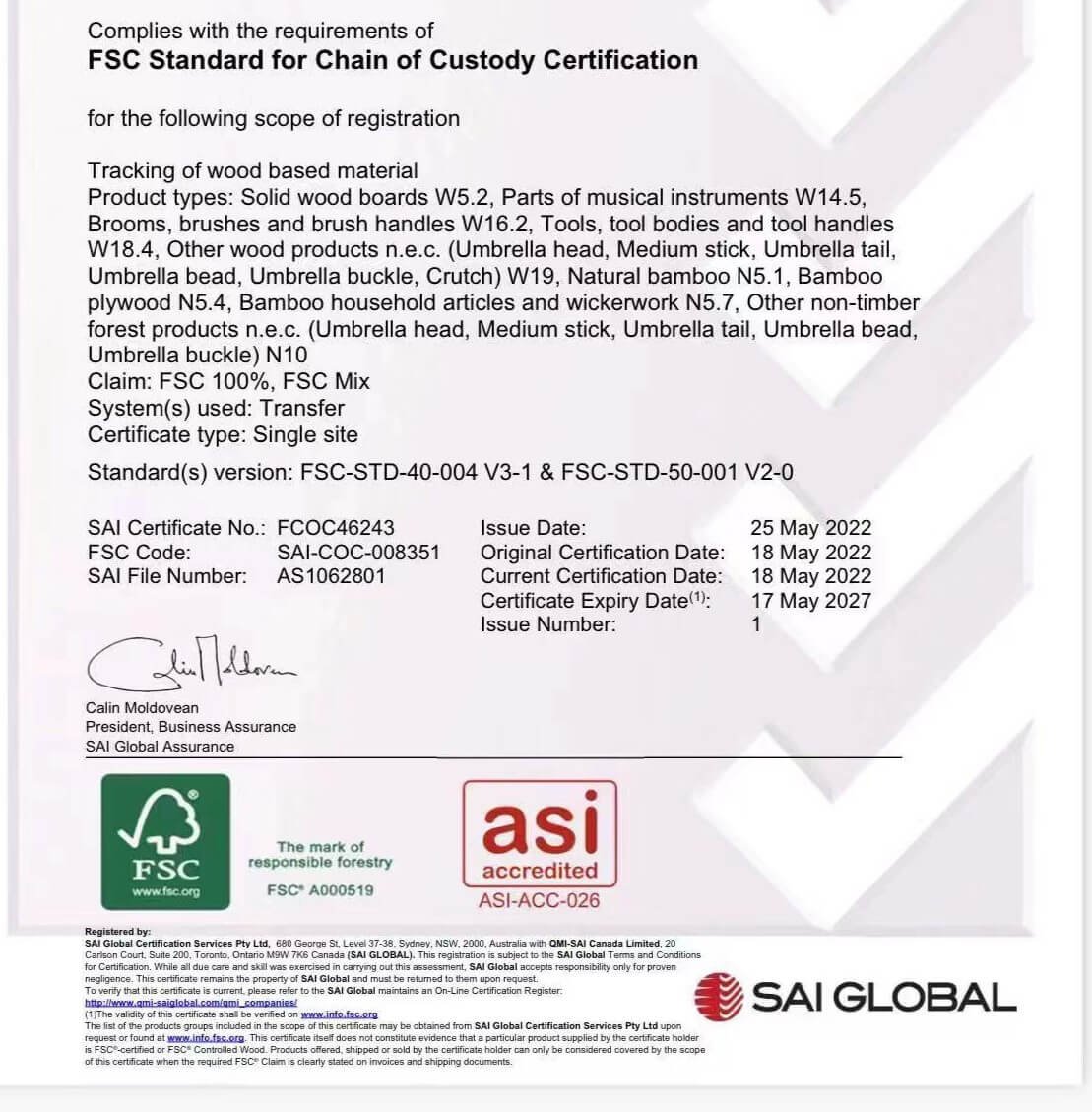
FSC certification addresses responsible sourcing and chain of custody for forest-based materials. Buyers who need an FSC claim should verify:
- the certificate holder supplying the component;
- the valid certificate scope;
- the material claim shown on transaction documents;
- whether subsequent processing keeps the chain of custody intact; and
- whether the planned product label or marketing claim requires approval.
Material quality still matters. Wood and bamboo components need controlled moisture content, proper drying, stable finishing and suitable packaging. Otherwise, handles can crack, warp or develop mould during humid storage and sea transit.
We also recommend testing the coating and adhesive used on the handle. Replacing a plastic handle with bamboo achieves little if the component fails early or uses an unsuitable surface treatment.
Durability Comes Before Marketing
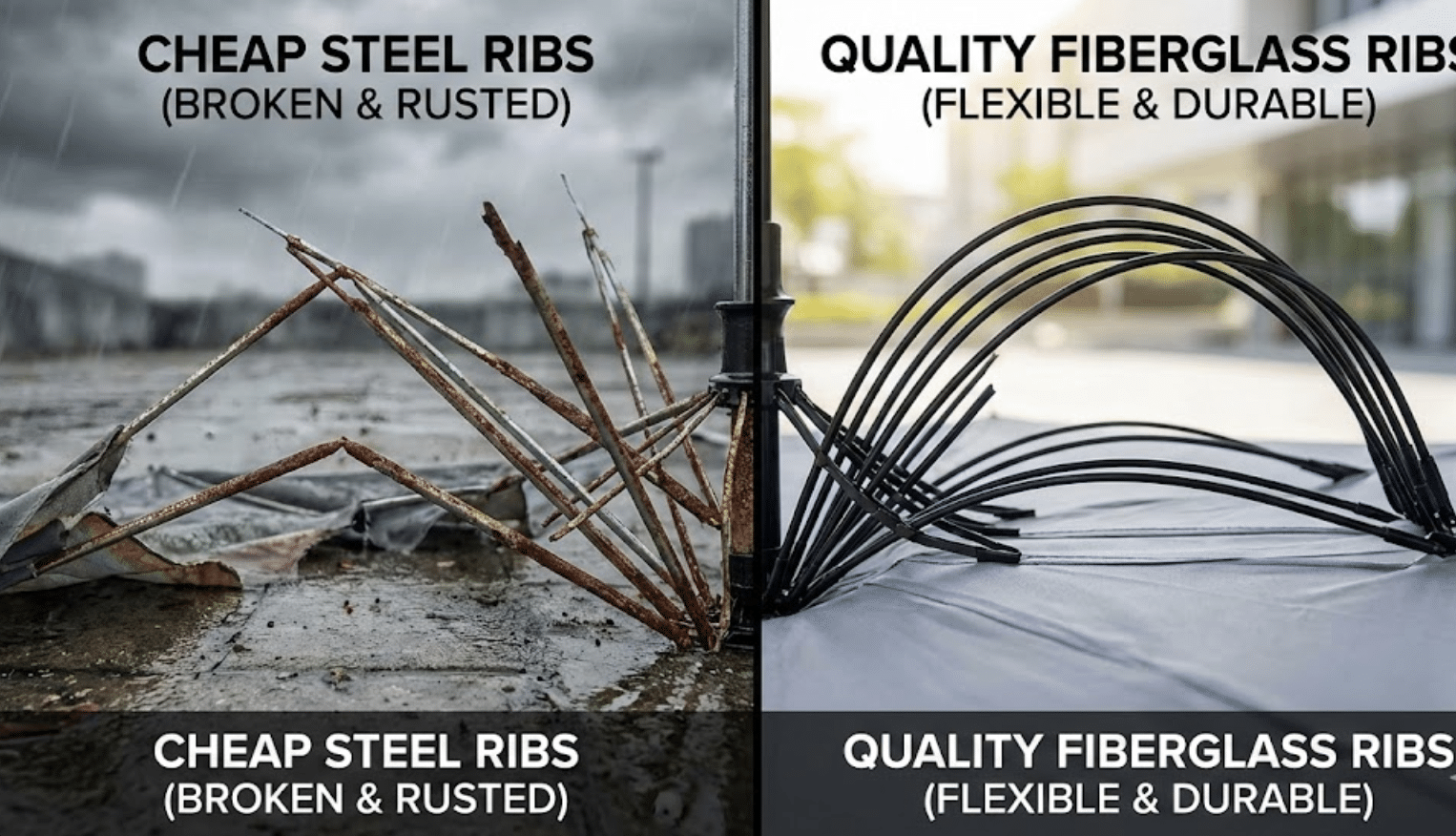
The frame normally causes more customer complaints than the canopy material. A recycled canopy on a weak frame may look good in a sustainability presentation, but it creates waste when the umbrella turns inside out or the runner fails.
For custom eco-friendly umbrellas, we normally review:
- shaft wall thickness and straightness;
- rib material and joint construction;
- runner movement;
- spring force on automatic models;
- tip, cap and handle attachment;
- opening-and-closing cycle performance;
- resistance to inversion and recovery; and
- the availability of replacement components for larger programs.
Fibreglass ribs can flex and recover better than low-cost rigid metal ribs in many wind conditions. However, the complete frame design matters more than one material name. Rib geometry, joint quality, canopy tension and assembly consistency all affect performance.
Be cautious with dramatic “windproof” figures. A wind-tunnel result only has value when the supplier identifies the test setup, wind speed, umbrella orientation, duration, failure criteria and exact model tested. Real wind is turbulent and changes direction; a clean laboratory number cannot guarantee that an umbrella will survive every storm.
Designing an Umbrella for Easier Disassembly
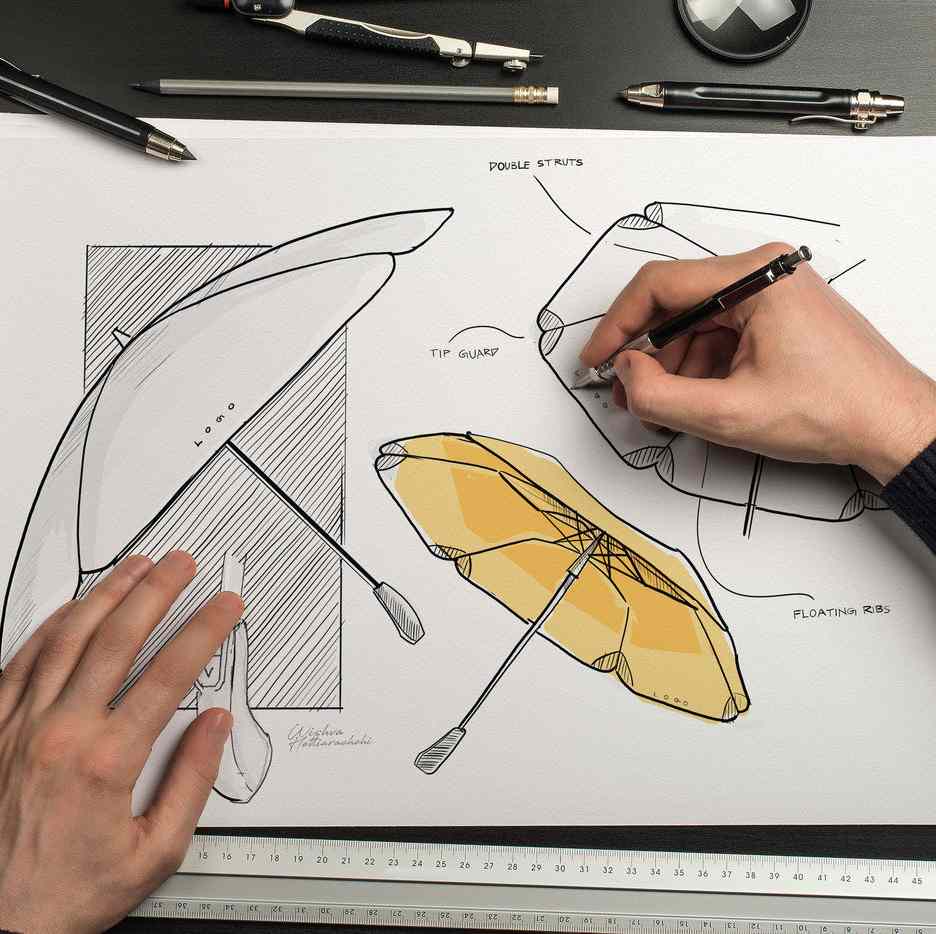
Umbrellas are difficult to recycle because they combine several small materials in one compact structure. Full circularity is not yet realistic for most commercial umbrella programs, especially where local recycling facilities do not accept fibreglass or small mixed components.
Nevertheless, manufacturers can improve the design:
- use mechanical fasteners where they are practical;
- reduce unnecessary adhesive;
- avoid decorative components that add little function;
- make the canopy easier to remove from the frame;
- mark major plastic materials where feasible;
- use replaceable handles, caps or tips on larger programs; and
- provide disassembly information for customers running a take-back scheme.
We describe this as circularity-oriented design, not a fully circular umbrella. The distinction matters. Easy separation creates an opportunity for recycling; it does not guarantee that recycling will happen.
What Sustainable Umbrellas Really Cost
There is no reliable universal premium such as “RPET always costs 5% more.” The final difference depends on the umbrella model, order quantity, fabric availability, certification route, printing, testing and packaging.
The following matrix is a useful planning tool, not a quotation:
| Sourcing level | Typical specification | Evidence to request | Main cost drivers |
|---|---|---|---|
| Material improvement | RPET canopy, durable standard frame, reduced packaging | Recycled-material documentation appropriate to the intended claim | RPET fabric availability, colour, printing and MOQ |
| Verified chemical specification | RPET canopy with specified non-fluorinated DWR and stronger frame | Relevant recycled-content documentation plus an accredited test report for the agreed substances | Testing scope, laboratory fees, coating and sample preparation |
| Expanded responsible sourcing | Verified recycled canopy, responsibly sourced wood component, optimised packaging | Applicable recycled-content and wood chain-of-custody documents, chemical tests and packaging specification | Certification chain, custom components, testing and order complexity |
| Circularity-oriented program | Long-life construction, reduced adhesive, replaceable or separable components | Approved bill of materials, assembly details, durability results and end-of-life instructions | Engineering work, tooling, lower-volume components and validation |
Testing costs are often fixed rather than proportional. Therefore, a USD 500 laboratory program has a much greater unit impact on 500 umbrellas than on 10,000. Custom-dyed RPET fabric can also require a higher minimum quantity than stock fabric. Buyers should define the required evidence before asking for the final price.
Nine Questions to Ask a Sustainable Umbrella Manufacturer
Use these questions before approving a purchase order:
1. What exactly contains recycled material?
Ask whether the claim covers the canopy, sleeve, handle, packaging or another component. Request the percentage and basis of calculation.
2. Does the Scope Certificate cover the relevant company and activity?
Check the legal name, site, validity dates, product category and processing scope. A certificate belonging to an unrelated fabric supplier does not cover every downstream product.
3. Can the shipment receive the required transaction documentation?
Confirm this before ordering. Do not assume the supplier can arrange a TC after the goods have shipped.
4. What does the PFAS report actually test?
Review the sample description, analyte list, method, reporting limits, laboratory accreditation and test date.
5. How will the supplier verify water repellency?
Agree on the material test and finished-umbrella rain test. Also define the acceptance level.
6. What colour tolerance applies?
RPET, virgin polyester and different printing processes may reproduce the same Pantone colour differently. Approve a physical colour standard and agree on an appropriate Delta E tolerance where instrumental measurement is necessary.
7. How has the frame been validated?
Request opening-cycle, functional and wind-performance information that relates to the exact frame—not a different umbrella used in a sales video.
8. Which environmental claims may we print?
Artwork, hangtags and packaging claims should match the evidence available for the finished order. Certification logos often have separate approval rules.
9. What happens if a material or component changes?
The purchase specification should require approval before the factory substitutes fabric, coating, frame parts, handle material or packaging.
A Practical Procurement Process
The cleanest sustainable umbrella projects follow a simple order of work.
Step 1: Define the intended claim
Decide what the brand needs to say: recycled canopy, specified recycled percentage, PFAS-tested fabric, FSC-certified component, reduced-plastic packaging or a combination. Do not start with a vague instruction to “make it eco-friendly.”
Step 2: Match the evidence to the claim
List the certificates, transaction documents and laboratory reports required by the destination market and the buyer’s own compliance team.
Step 3: Build the physical specification
Select the umbrella size, frame, mechanism, canopy fabric, coating, handle, printing and packaging. Sustainability should not sit in a separate document from product quality.
Step 4: Confirm feasibility and costs
Check material MOQs, certification availability, testing fees, tooling, sample time and production lead time.
Step 5: Approve a representative sample
The sample should use the intended construction. If the factory uses digital printing for a fast visual sample but plans screen printing or dyed fabric for bulk production, record that difference in writing and approve the relevant colour standard separately.
Step 6: Control the production order
Use an approved specification sheet, bill of materials, artwork, packaging standard and inspection criteria. Require written approval for substitutions.
Step 7: Complete testing and shipment documentation
Make sure reports describe the correct material or finished product. Verify certificate details and transaction documents rather than filing screenshots supplied through a chat message.
How HF Umbrella Approaches Sustainable Custom Umbrellas
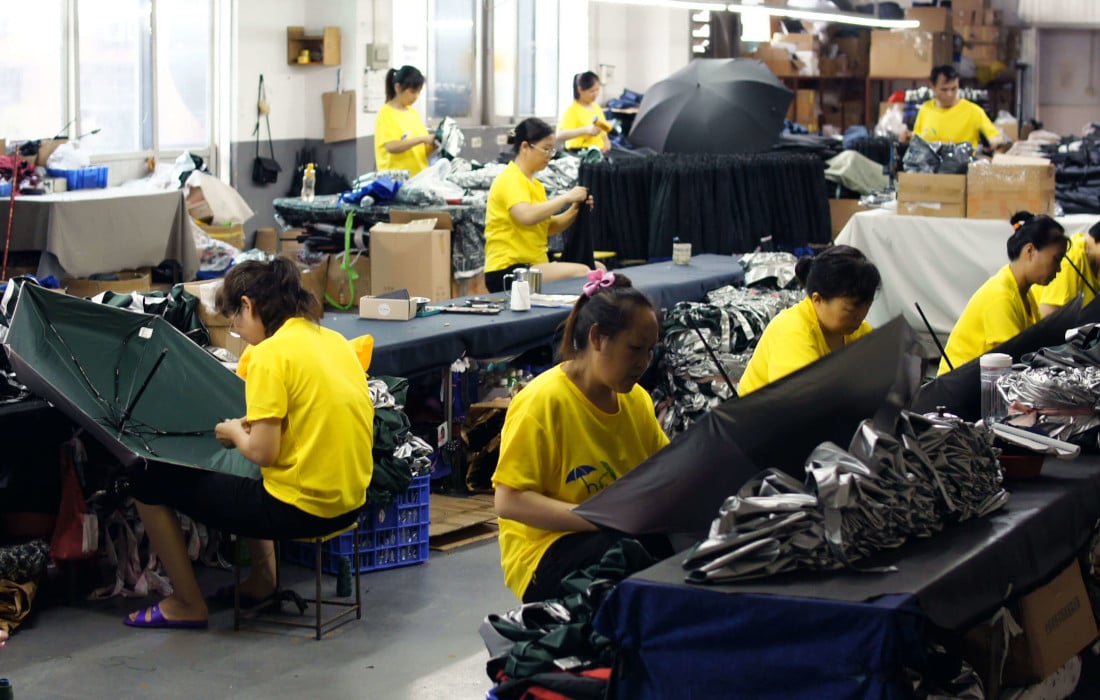
Huifeng Umbrella has specialised in custom umbrella manufacturing for more than 30 years. We work with brands, promotional-product companies, galleries, retailers and corporate buyers that need more than a logo printed on a stock umbrella.
Our role is to help the buyer turn an environmental objective into a manufacturable specification. Depending on the model, quantity, selected supply chain and documentation requirements, we can support options such as:
- RPET canopy and sleeve materials;
- custom digital, sublimation and screen printing;
- non-fluorinated water-repellent fabric options;
- bamboo or responsibly sourced wood components, subject to documentation availability;
- fibreglass frame configurations designed for longer service life;
- reduced-plastic or custom paper packaging;
- third-party material and chemical testing; and
- quality inspection with agreed AQL and functional checks.
We confirm certification and testing availability for each project before accepting the claim. That is important because the correct documentation depends on the legal entities, materials, processing steps and shipment involved.
We would rather narrow a marketing claim than give a buyer paperwork that does not support the finished product.
Frequently Asked Questions
Are RPET umbrellas fully recyclable?
Usually not through ordinary household recycling. The canopy may contain recycled polyester, but the umbrella also contains metal, fibreglass, plastic and other components. A removable canopy and separable construction can improve end-of-life options where appropriate recycling facilities exist.
Is a GRS Scope Certificate enough?
No. A Scope Certificate shows that a named organisation is certified for specified activities and products during a defined period. It does not prove that a particular shipment of finished umbrellas is certified. Ask whether the relevant goods can receive a valid Transaction Certificate or other required transaction documentation.
Does an SGS report mean the umbrella is PFAS-free?
Not automatically. SGS, Intertek and other laboratories test the sample against the requested method and substance list. Buyers must review what was tested, the reporting limits and whether the sample matches the production material.
Can you make sustainable promotional umbrellas with a low MOQ?
Often yes, especially when using available RPET colours and standard frames. Custom-dyed fabric, special components, certification and testing may increase the practical MOQ. Huifeng reviews this project by project rather than advertising one MOQ for every specification.
Can RPET fabric carry photographic or all-over artwork?
Yes. Digital or sublimation printing can reproduce detailed artwork on suitable RPET polyester fabric. The best printing method depends on artwork, quantity, colour requirements, fabric construction and whether the print appears inside or outside the canopy.
What files do you need for custom printing?
Vector artwork in AI, CDR or vector PDF is preferred for logos and graphic elements. For photographic printing, supply high-resolution artwork at the required production scale. Pantone references are useful, but buyers should still approve a physical print or colour sample because screen and fabric colours differ.
How long does sampling take?
A straightforward sample using available materials may take approximately 3–5working days. Custom-dyed fabric, new moulded components, specialised printing or laboratory validation will take longer. Shipping time is additional.
Final Advice: Buy the Evidence, Not the Adjective
Words such as green, eco, conscious and planet-friendly are not technical specifications.
A better purchase order identifies the recycled-content claim, material source, certificate scope, transaction-document requirement, restricted-substance standard, test method, performance target, approved sample and substitution controls.
That may sound less exciting than a leaf icon and a green swing tag. It is also far more useful.
If you are developing custom sustainable umbrellas, send us the intended market, model, quantity, artwork and required environmental claims. We can review the specification, explain which claims can be supported and prepare a practical quotation.
Email: info@hfumbrella.com
Website: www.hfumbrella.com
About the Author
Justin | Huifeng Umbrella
Justin works in custom umbrella development and export manufacturing at Huifeng Umbrella. His work covers canopy materials, printing, frame construction, sampling, quality control and international B2B orders. Huifeng has supplied custom umbrellas for more than 30 years.
Editorial note: This article provides general procurement information, not legal advice. Regulations, certification rules and test requirements change. Buyers should confirm the requirements that apply to their product, sales market and environmental claims before placing an order.
Last reviewed: August 2026
Authoritative References
- Textile Exchange — Supply Chain Certification
- Textile Exchange — Transaction Certificate
- Textile Exchange — Content Claim Standard
- European Commission — Green Claims
- EUR-Lex — Ecodesign for Sustainable Products Regulation, Regulation (EU) 2024/1781
- California Legislative Information — AB 1817
- Cascale — Higg FEM Verification