
Table of Contents
Single-Layer Double-Sided Umbrella Printing: Why I Hate “Double-Layer” Umbrellas
Let’s be honest for a second. The industry has been stuck in the past, and it’s time to talk about the revolution of Single-layer double-sided umbrella printing.
As a manufacturer, I should love getting orders for traditional double-layer umbrellas. Why? Because I get to sell you twice the fabric. It’s great for my revenue.
But as an engineer, I hate them.
Especially for folding umbrellas. When you sew two layers of cloth together just to show a pattern on the inside, you create a monster. It’s bulky. It’s heavy. And trying to fold it back into its sleeve is like trying to stuff a sleeping bag into a Pringles can.
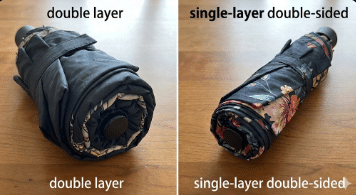
But for years, museum buyers told me: “Justin, we have no choice. If we only use one layer, the print bleeds through.”
I got tired of choosing between “Ugly” and “Bulky.” So, we developed a proprietary method for Single-layer double-sided umbrella printing.
THE BREAKTHROUGH:
The problem wasn’t the printer; it was the canvas.
Standard umbrella fabric (190T Pongee) is too porous. Ink soaks right through.
Our Solution: We sourced a specialized High-Density 260T Pongee. It is woven so tightly that it acts like a solid sheet of paper.
We then calibrated our heads for Dye-Sublimation Printing on BOTH sides simultaneously. Same fabric. Two different images. Zero bleed-through.
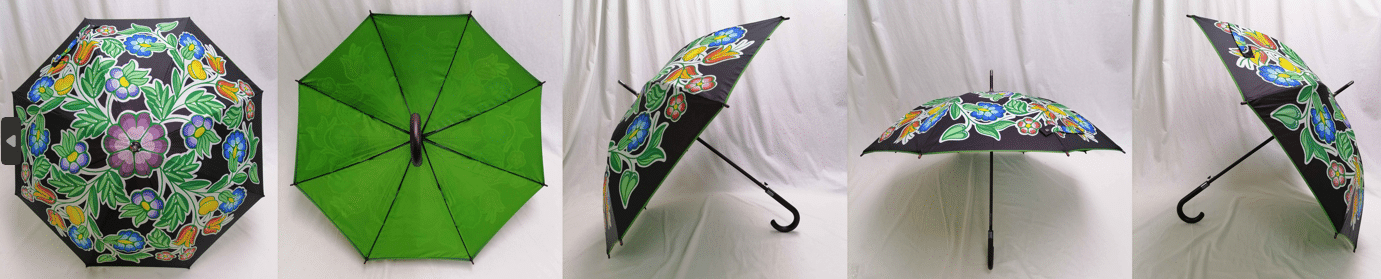
As you can see in the image above, the exterior features a complex, multi-colored floral design, while the interior is a clean, vibrant solid green. This is all done on one single layer of fabric. No extra bulk, no extra weight.
The Touch Test: Single-Layer Double-Sided Umbrella Printing vs. Double Layer
You have to feel this to understand the difference. It changes the entire perception of the product.
❌ The Old Way
(Double Layer)
- Thickness: ~0.45mm (Too thick)
- Weight: Heavy (Double the fabric weight)
- Folding: Messy & Wrinkled
- Feel: “Clunky”
✅ The HF Innovation
(Single Layer Dual-Print)
- Thickness: ~0.18mm (Razor thin)
- Weight: Featherlight
- Folding: Snaps shut with crisp pleats
- Feel: “Premium Tech”
Who is this actually for?
I want to be clear: This is not for everyone.
If you are buying cheap promo umbrellas, stick to screen printing. But if you are managing a Museum Gift Shop or a Designer Brand, this is for you.
This technology is particularly popular with our Museum & Gallery Clients who demand high fidelity art reproduction.
Imagine selling an umbrella at the MoMA gift shop. The outside is Black. The user opens it, and Boom—they are standing under a vibrant Van Gogh sky. With Single-layer double-sided umbrella printing, that umbrella fits in a pocket.
And yes, the color fastness meets ISO 105-B02 standards.
FAQ: Single-Layer Dual Print Technology
What is Single-Layer Dual Print Technology?
Single-Layer Dual Print Technology allows different designs on the outside and inside of an umbrella
using only one layer of fabric. It achieves dual-side visuals without adding extra fabric, keeping
the umbrella lightweight and easy to fold.
Is this the same as a double-layer umbrella?
No. This is not a structural double-layer canopy.
A double-layer umbrella uses two separate fabric layers, often for wind ventilation.
Single-Layer Dual Print uses one fabric layer with controlled dual-side printing.
Why do museums usually choose double-layer umbrellas?
Museums traditionally choose double-layer umbrellas to avoid ink bleed-through,
faded inner designs, and visual contamination on light-colored interiors.
This technology was developed to solve those issues without adding a second layer.
Does Single-Layer Dual Print prevent ink bleed-through?
Yes, when done correctly. By using high-density woven pongee fabric,
calibrated digital print heads, and controlled ink saturation,
bleed-through can be effectively avoided.
Is this umbrella lighter than a double-layer umbrella?
Yes. Because it uses only one fabric layer, the umbrella is lighter,
less bulky, and easier to fold compared to traditional double-layer umbrellas.
Is Single-Layer Dual Print better than double-layer umbrellas?
It depends on the use case.
Choose Single-Layer Dual Print for lightweight design and visual storytelling.
Choose double-layer umbrellas for maximum wind ventilation and structural airflow.
Is this technology suitable for strong wind conditions?
Not specifically. This technology focuses on visual performance,
not aerodynamic wind-venting structure.
For extreme wind conditions, a traditional double-layer canopy is recommended.
Who is this technology best for?
It is ideal for museums, cultural institutions, exhibitions,
brand collaborations, and premium promotional umbrellas
where design matters more than extreme wind resistance.
Can the inside and outside have different designs?
Yes. Both sides can feature different artwork, colors,
or branding messages, making it ideal for story-driven designs.