
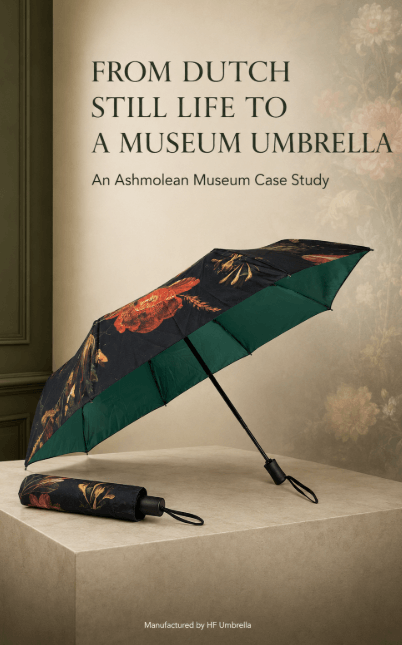
We recently came across this umbrella again on the Ashmolean Museum’s online shop.
It is a product we manufactured for our UK customer, for supply to the Ashmolean Museum in Oxford.
Seeing an umbrella we made being sold by a major museum is always satisfying. What made it even better was finding that The Independent had tested it in real rain and wind—and named it the Best Luxury Umbrella in its 2026 review.
So, here is a little more about how this umbrella was made.
Table of Contents
The design looks simple until you try to print it
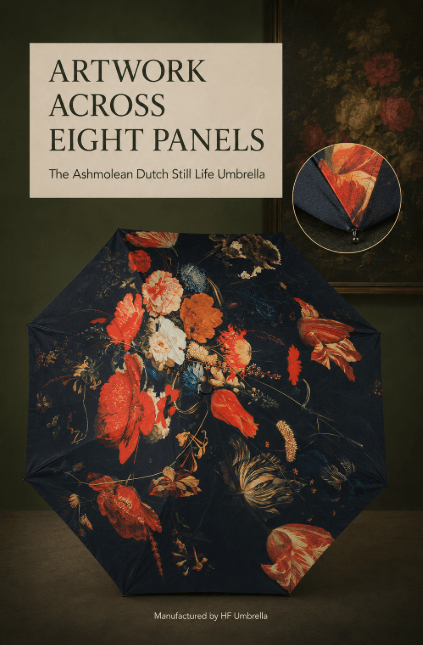
The outside canopy uses a Dutch still-life pattern filled with flowers, leaves and small insects. The background is very dark, so the colours need to remain clear without becoming unnaturally bright.
This type of artwork is more difficult to produce than a normal logo umbrella.
A painting is flat and rectangular. An umbrella is curved and divided into eight panels. Once we cut and sew the fabric, every seam passes through part of the image. Some details also become less visible when the umbrella is folded.
Before production, we had to consider where the main flowers would appear, how the pattern would continue between the panels and whether the smaller details would still be visible on the actual fabric.
A computer image can show the general effect, but it cannot tell you everything. We still need to make a real sample, open it, close it and look at it from different angles.
That is usually when we find the small problems.
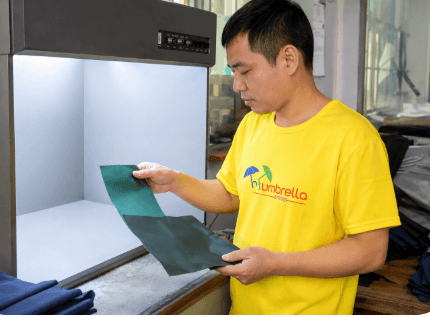
Why the inside is plain green
The outside is already visually rich, so repeating another detailed print inside would have made the umbrella feel too busy.
Instead, the inside canopy uses a plain earthy green. It works with the colours of the flowers but does not compete with them.
This also gives the umbrella a different feeling when viewed from underneath. The outside presents the artwork; the inside is quieter.
The double layer makes the canopy feel thicker and more substantial as well. That was suitable for a museum product selling at a higher retail position than an ordinary promotional umbrella.
The small details mattered
We used 210T pongee fabric with a steel and fibreglass frame. The umbrella opens and closes automatically, measures 105 cm when open and folds down to 29 cm.
The Automatic handle may seem like a small detail, but changing it to manual open would have changed the whole product. The autimatic button open and clsoe quickly and fits the colours and character of the artwork.
We also produced a matching sleeve and added a wrist loop, making it practical to carry every day.
The final product is compact, although it is naturally a little thicker than a basic single-layer folding umbrella.
Then somebody tested it in Welsh weather
Product descriptions are easy to write. Real-world reviews are more useful.
A reviewer from The Independent used the Ashmolean umbrella during wet and windy walks in South Wales. She liked the thick canopy, comfortable handle and the way the umbrella remained stable in the wind.
She also found that the canopy dried surprisingly quickly and described the umbrella as offering a good balance between appearance and performance.
Her only criticism was that the thicker folded canopy needed to be folded carefully to fit neatly back into its sleeve. That is fair. A double-canopy umbrella will always be slightly bulkier than a thin single-layer model.
Overall, the umbrella was selected as the publication’s Best Luxury Umbrella.
For us as the manufacturer, that is valuable feedback. The design attracted attention, but the umbrella also did its actual job in bad weather.
You can see the finished product on the Ashmolean Museum shop and read the independent test in The Independent.
A useful lesson for museum products
Museum merchandise should not be beautiful only when photographed.
People will open it, carry it in a bag, use it in the wind and try to put it back into the sleeve. The artwork matters, but so do the frame, fabric, handle and folded size.
When we develop an art umbrella, we check both sides of the product: how the artwork looks and how the umbrella works.
This Ashmolean umbrella is a good example. It began with a detailed museum pattern, but it became a practical product that someone could carry around Oxford—or test in the rain in South Wales.
That is the kind of museum product we like making.