
After long years in the umbrella trade, people often ask me what the real secret is to building a global manufacturing business. Is it about sourcing better materials? Buying more advanced machinery? Building a tighter supply chain?
Those things certainly help. But to be honest, after producing thousands of custom umbrellas for museums, luxury hotels, Ivy League universities, and global brands, I’ve realized something unexpected: most umbrella projects succeed or fail long before the production lines even turn on. The manufacturing itself is rarely the hardest part. Understanding the human being on the other end of the email is.
Here are five honest lessons I’ve learned from the factory floor.
Lesson 1: Customers Don’t Buy Umbrellas. They Buy Certainty.
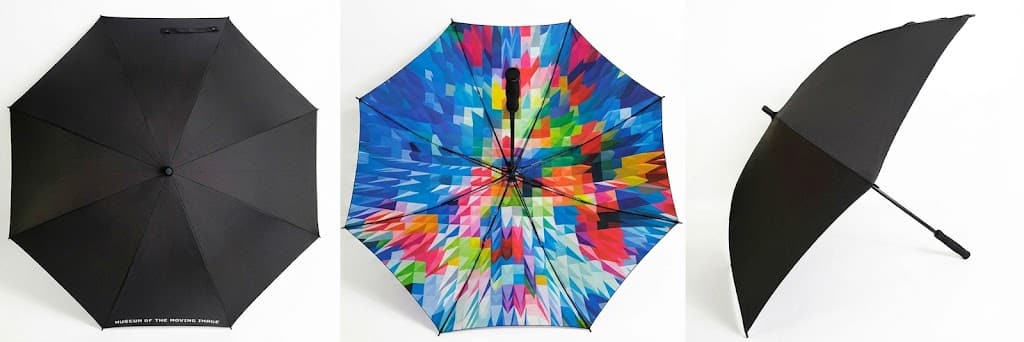
Several years ago, we were approached by the Museum of the Moving Image in New York. At first glance, it looked like a straightforward project—just a custom umbrella for their museum gift shop. But as our discussions progressed, it became clear that they weren’t just buying rain gear; they were trying to extend a premium exhibition experience into the streets.
The outer canopy featured a clean, minimal design, but the inside was filled with complex, colorful geometric artwork. The challenge wasn’t the printing itself; it was the meticulous alignment. A tiny 2mm misalignment that a traditional engineer might overlook on a factory floor mattered deeply to their design team.
It took us nearly four months of shifting artwork files back and forth between New York and our factory, fine-tuning the Pantone matching and fabric tension. When the finished containers finally arrived in New York, the client’s praise wasn’t about the ribs or the shafts. It was about the relief that the final product looked exactly like what they had envisioned. That project taught me a permanent lesson: high-end clients aren’t shopping for a commodity. They are paying for the certainty that their brand won’t be compromised.
Lesson 2: The Cheapest Quote Is Often the Most Expensive Decision
Every single week, we receive inquiries from buyers comparing five or six different quotations. That’s just business. But one specific conversation always stands out in my memory. A prospective customer sent me a competing quote from another supplier and asked if we could match it.
I looked at the numbers and shook my head. The quoted price was lower than our raw material and labor costs, even before shipping. Could we reduce our price slightly by scaling up the volume? Sure. But could we hit that specific number? No. Because proper quality control, decent wages, and reliable components have a floor price. I politely declined the order.
Two years later, that same buyer came back to us. The lower-priced supplier had delivered the order, but the savings quickly evaporated. The frames failed in moderate winds, the logo printing started peeling after two rains, and their customer returns skyrocketed. What looked like a bargain on paper ended up as a massive headache and a hit to their brand reputation. Since that day, when a buyer asks me to just “beat the lowest price,” I tell them honestly: we aren’t interested in winning a race to the bottom. We are interested in the total, trouble-free cost of your project.

Lesson 3: Good Design Doesn’t Stop at the Canopy
Most people assume that custom umbrella design begins and ends with the canopy artwork. But some of the most brilliant brand managers we work with think entirely differently.
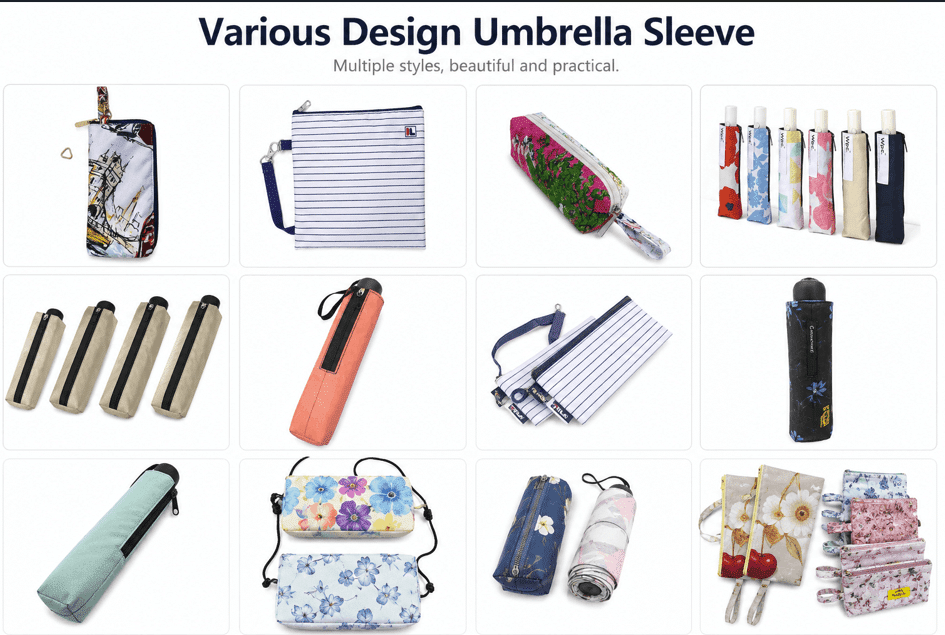
Recently, while reviewing our past portfolio, I noticed a fascinating trend. Many of our most memorable and successful corporate gift projects weren’t successful because of the umbrella alone. They were successful because of the sleeve and packaging.
I remember a fashion client who spent weeks perfecting the umbrella artwork, but surprisingly, they spent twice as much time engineering the matching sleeve. Their reasoning was flawless: a consumer might open an umbrella thirty times a year when it rains, but they carry that sleeve hundreds of times—tucked into a handbag, placed on a boardroom table, or held on public transport. The sleeve is actually the most visible real estate. It changed how we advise our clients. True product design isn’t about decorating more surfaces; it’s about understanding where the end-user actually interacts with the product daily.
Lesson 4: Innovation Usually Starts With an “Impossible” Request
A few years back, a client from the golf sector approached us with a request that sounded completely contradictory. He wanted a golf umbrella large enough to cover both the player and a bulky golf bag, sturdy enough to withstand heavy coastal winds, yet significantly lighter than any traditional model on the market.
To a standard engineer, those specs fight each other. Bigger usually means heavier. Stronger usually means thicker, more cumbersome materials.
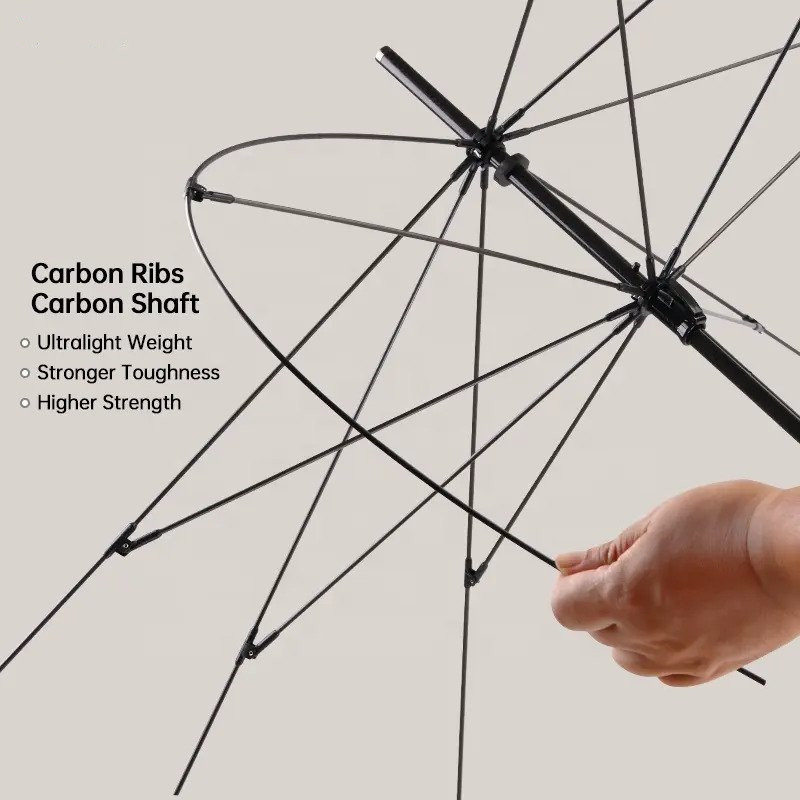
Instead of saying “no,” our technical team began prototyping. We went through rounds of trial and error—testing different structural densities of carbon fiber, modifying the resin content, and redesigning the fiberglass ribs. We had plenty of prototypes snap during wind-tunnel simulations. But by refusing to settle, we eventually rolled out a carbon fiber golf umbrella that weighed approximately 330 grams without sacrificing an ounce of strength. That breakthrough didn’t come from a sterile laboratory research fund; it came directly from a customer’s frustration.
Lesson 5: Trust Is Built When Things Go Wrong
Many of our longest-running client relationships—companies that have been with us for over a decade—didn’t start with massive purchase orders. They started with a small, cautious test.
Over the decades, I’ve realized that trust isn’t built when everything goes perfectly. Manufacturing involves human hands, global logistics, and unpredictable weather; it is never 100% perfect. True trust is forged in how a supplier handles the unexpected—a sudden port strike, a last-minute artwork revision, or a material shortage.
How a factory owner responds in those high-pressure moments matters more than any marketing copy on a website. We stay in business because when a challenge arises, we don’t hide behind contract clauses. We communicate transparently, pick up the phone, and absorb the cost to make it right.

Looking Ahead
The global umbrella industry is changing faster than ever. We are seeing a massive shift toward sustainability—with more brands demanding certified GRS-compliant recycled fabrics (RPET) to meet their environmental goals. Printing technologies are becoming sharper, and shipping lanes are becoming more volatile.
Yet, after more than three decades in this industry, the core fundamentals of what I do remain remarkably simple: listen to what the client is actually trying to achieve, tell the truth, obsess over the millimeters, and deliver exactly what was promised.
People look at our facility and see a factory that manufactures umbrellas. But if you ask me, what we really manufacture is confidence. The umbrella is just the final product.
About Justin & HFumbrella
As the General Manager of HFumbrella, We have spent over 30 years helping museums, corporate brands, and independent designers bring their custom umbrella collections to life. Whether you are a startup looking to launch a flexible 25-piece small-batch collection, or a global enterprise requiring a streamlined, 15-day global production-to-delivery pipeline, our mission is to make your manufacturing experience completely predictable, reliable, and stress-free.
📥 Let’s Build Something Predictable Together
Have a challenging custom project, a strict deadline, or an “impossible” design in mind? Don’t risk your brand on guesswork. Let’s talk about how we can bring your vision to life with 100% certainty.
Click Here to Contact Justin Directly & Get a Quote Within 24 Hours
(Or email me your artwork files directly at: info@hfumbrella.com)