

How to Make a Promotional Umbrella People Will Actually Use
A promotional umbrella only works if people actually use it.
It sounds obvious, but it is easy to forget when developing a promotional product. Much of the discussion often starts with the logo: How big should it be? How many panels should we print? Which Pantone color should we use?
Those questions matter, but they should come later.
First, think about the person who will receive the umbrella. Where will they use it? Will they carry it every day, keep it in a car, use it on a golf course or take it to an outdoor event?
The answers can change the type of umbrella you should make.
Table of Contents
1. Start with the User, Not the Logo
Different situations call for different umbrellas.
A golf umbrella offers good coverage and a large area for branding, but it is not something most people want to carry on a daily commute.
A folding umbrella fits easily into a bag and works well for employee gifts, conferences and general corporate use.
A walking umbrella with a wooden handle may suit a hotel, museum or traditional brand where appearance matters.
For travel-related projects, a compact and lightweight umbrella may make more sense than a larger model.
Before discussing printing, decide how you expect people to use the umbrella.
That usually makes the next decisions easier.
2. Bigger Is Not Always Better
A large umbrella gives you more coverage and more space for branding. That does not automatically make it a better promotional product.
Consider a 60-inch golf umbrella. It can work very well for golf events, hotels or automotive promotions. But for someone taking a train to work every morning, a compact folding umbrella is probably more useful.
The same applies to weight.
A stronger or larger frame usually adds weight. A very lightweight umbrella may require a smaller canopy or different frame materials.
There is always some balance between size, weight, strength and cost.
The best specification depends on how the umbrella will actually be used.
3. You Don’t Have to Print the Logo Everywhere
An umbrella gives you a lot of printing space.
You do not have to use all of it.
Sometimes one well-positioned logo looks better than the same large logo printed across every panel.
For a promotional event, strong and visible branding may be exactly what you need. For a museum, hotel, fashion brand or premium corporate gift, a quieter design may work better.
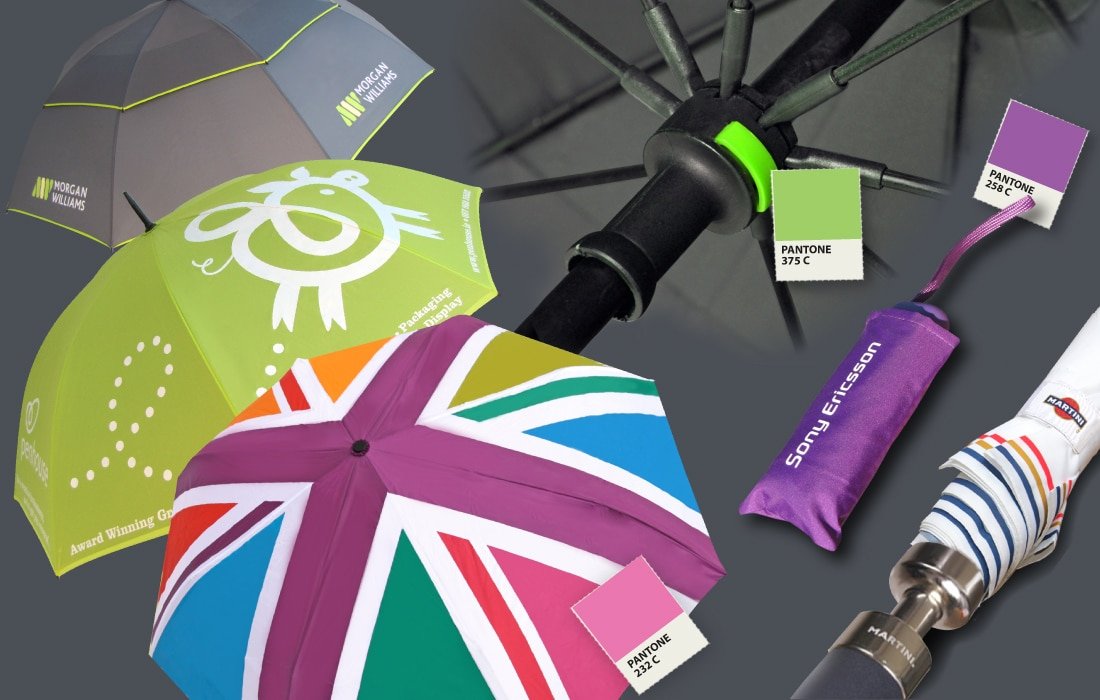
The canopy color, handle, tie wrap and other details can already communicate part of the brand identity without filling every available space with logos.
Before adding another logo, it is worth asking whether it improves the umbrella or simply makes it busier.
4. Match the Quality to How Long You Want It to Last
Not every promotional umbrella needs the same specification.
If you are ordering several thousand umbrellas for a one-day event, a simple and reasonably priced model may be the right choice.
If the umbrella is a gift for an important client, part of a hotel guest experience or a product sold in a museum shop, the expectations are different.
In those cases, it may make sense to spend more on the fabric, frame, handle, printing or finishing.
This does not mean that expensive is always better.
It means the specification should match the purpose.
There is little value in adding expensive features that the user will never notice. At the same time, saving a small amount on an important component can be a poor decision if you expect people to use the umbrella for several years.
5. Think About the Umbrella When It Is Closed
Most umbrella designs are created around one image: the umbrella fully open.
That makes sense because the open canopy has the biggest visual impact.
But an umbrella spends a lot of its life closed.
When closed, the user sees and touches different parts of the product: the handle, tie wrap, sleeve and wrist strap. They also notice the folded size and weight.
These details can be useful parts of the design.
A logo on the tie wrap can remain visible when the umbrella is closed. A well-designed sleeve can make a folding umbrella feel more complete. A wooden handle can change the appearance of a walking umbrella even before it is opened.
The open canopy matters, but it is not the whole product.
6. Design for an Umbrella, Not a Flat Screen
This is particularly important for custom printed umbrellas.
Artwork is usually created on a flat computer screen. An umbrella is not flat.
The canopy consists of separate fabric panels that we print, cut, sew and stretch over a curved frame.
That changes how artwork behaves.
A large circle crossing several panels may not look perfectly circular once the umbrella is open. Text positioned too close to a seam can become difficult to read. Faces, buildings or other important parts of an illustration may look strange if a seam runs through them.
With full-canopy printing, small adjustments to the original artwork can often make production easier and the finished result better.
For this reason, it is useful to review the artwork on an umbrella template before making a sample.
7. Choose the Printing Method After You Know the Design
There is no single printing method that works best for every custom umbrella.
For a simple logo using one or two solid colors, screen printing is often a practical choice.
For photographs, illustrations, gradients or artwork covering most of the canopy, digital printing usually offers more flexibility.
The fabric also matters. A printing method that works well on one material may not give the same result on another.
Instead of choosing a printing method first, it usually makes more sense to look at the artwork, quantity, fabric and required result together.
8. Don’t Forget Shipping
Shipping is easy to ignore when choosing an umbrella, especially at the beginning of a project.
For international orders, it can become an important part of the total cost.
A golf umbrella and a folding umbrella may have a similar unit price, but they are very different products to pack and ship. Long umbrellas take up more space, while folding umbrellas can usually be packed into smaller cartons.
This becomes particularly important when the delivery date is tight and the order needs to travel by air.
If you already know that an order must arrive before a particular event, consider the delivery method when choosing the umbrella rather than waiting until production is finished.
Sometimes changing the umbrella size or construction can make more sense than paying a much higher shipping cost later.
9. Make a Sample Before Making Thousands
Artwork on a screen is still artwork on a screen.
A physical sample lets you see the actual canopy color, printing, logo position, handle, frame and overall proportions.
For a simple repeat order, a new sample may not always be necessary. But for a new design, unusual printing or a project where color and appearance matter, sampling can prevent expensive mistakes.
If time is limited, photos and videos may be enough to approve some projects without shipping the physical sample internationally.
The important thing is to check the details before bulk production starts.

A Good Promotional Umbrella Doesn’t Need to Be Complicated
There is a temptation to add more when developing a custom product.
Another logo. Another printed panel. A different handle. Special packaging. More colors.
Sometimes those details make sense. Sometimes they do not.
A simple umbrella in the right size, with a good canopy color and one carefully positioned logo, can work better than a much more complicated design.
Start with the user and the purpose of the project. Then decide the umbrella type, specification, artwork and printing method.
If people like the umbrella, they will use it.
And if they use it, your brand goes with them.
Planning a Promotional Umbrella Project?
Tell us the quantity, intended use, artwork and required delivery date.
Discuss Your Project →